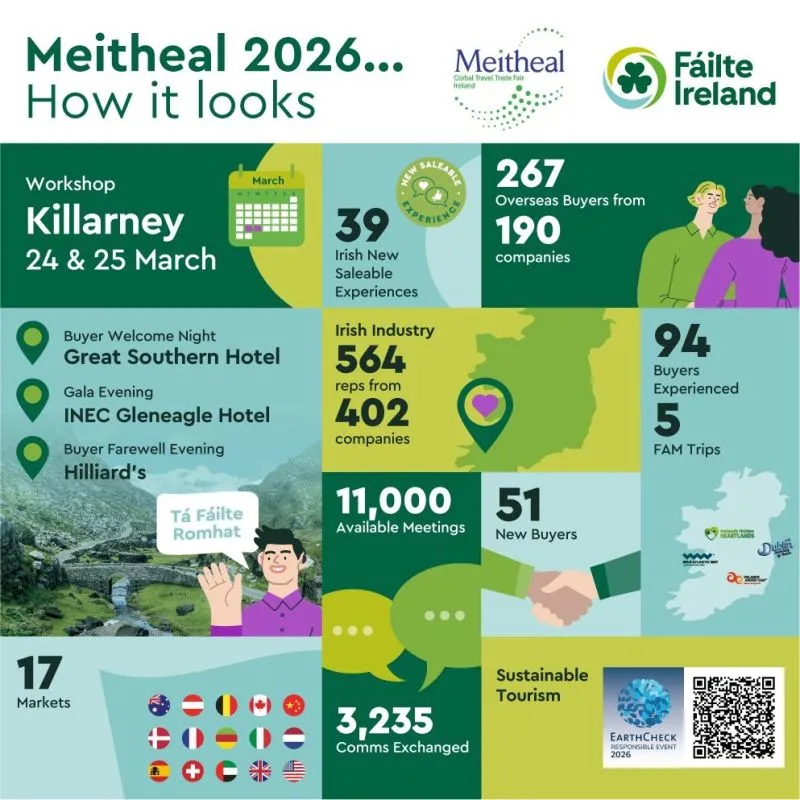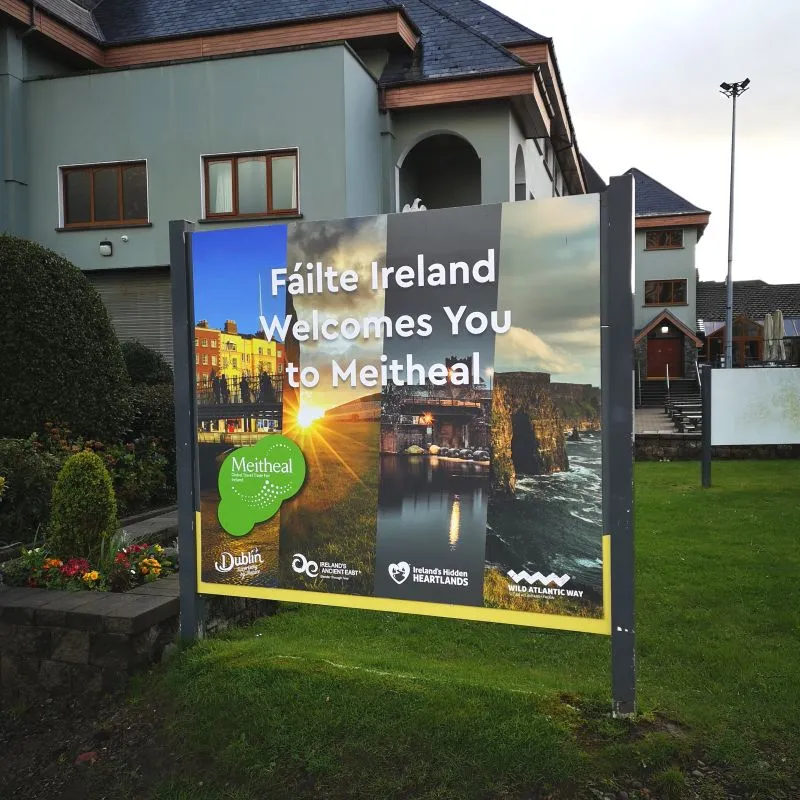
For over five decades, Meitheal has stood at the heart of Ireland’s tourism industry. Established in 1975 and delivered by Fáilte Ireland in partnership with Tourism Ireland, it has evolved into the country’s flagship international trade event – a powerful platform connecting Irish tourism businesses with buyers from across the globe. In addition to the trade show, international buyers travelled throughout Ireland on bespoke itineraries designed by Fáilte Ireland to experience first-hand the depth and quality of the country’s tourism offering. These trips featured experiences across Ireland’s Hidden Heartlands, the Wild Atlantic Way, Ireland’s Ancient East, and Dublin.
Bringing together 402 Irish businesses, 267 international buyers and tour operators from 17 countries for over 11,000 pre-scheduled meetings at the end of March, Meitheal remained a hub of commercial opportunity. But behind the scenes, it also became a showcase for Ireland’s leadership in sustainable business events – demonstrating that economic success and environmental stewardship are not only compatible but mutually reinforcing.
Set against the scenic backdrop of Killarney, County Kerry – a destination ranked among the world’s most sustainable – Meitheal 2026 was not just about promoting Ireland as a tourism destination. It was about redefining how tourism events themselves can operate responsibly, with sustainability embedded at every level.
Sustainability was not an add-on at Meitheal 2026 – it was foundational. Guided by Fáilte Ireland’s Meitheal Sustainability Policy 2024 – 2026 as part of a three-year plan and aligned with Ireland’s Business Events Strategy 2030, the event was structured around three key pillars: environmental responsibility, social impact, and economic value.
These pillars were translated into tangible action through clearly defined commitments aligned with the United Nations Sustainable Development Goals. The approach positioned Meitheal not just as a trade event, but as a living example of best practice in sustainable event management.
A defining feature of Meitheal 2026 was its commitment to data-driven sustainability. Carbon footprint measurement played a central role, with emissions tracked across travel, accommodation, and food, and has indicated a 31% overall reduction compared to Meitheal 2025. Importantly, the carbon report was prepared in advance, allowing organisers to communicate insights directly with delegates and encourage shared responsibility. This transparency helped shift attitudes from passive participation to active engagement.
To further support sustainable behaviour, a Sustainable Delegate Guide was shared with attendees in advance, providing practical tips on reducing environmental impact throughout the event.
Travel is often the largest contributor to a conference’s carbon footprint. At Meitheal 2026, organisers encouraged buyers and delegates to travel by coach rather than short-haul flights, reducing emissions significantly.
Food and hospitality were also carefully considered, with 75% of food sourced locally from the Killarney region. Delegates pre-ordered meals, helping to minimise food waste – a persistent challenge in large-scale events. Venues including The Great Southern Hotel, The Brehon Hotel, and The Gleneagle Hotel were selected for their commitment to sustainable practices, ensuring alignment between ambition and execution.
International buyers were introduced to sustainable Irish suppliers, many participating in Fáilte Ireland’s Climate Action Programme, extending the event’s impact beyond its duration.
Meitheal 2026 also placed strong emphasis on social impact, recognising that sustainability is about people as much as planet.
A standout initiative was the engagement with Transition Year students from Scoil Phobail Sliabh Luachra. Students participated in guided tours, interactive sessions, and discussions on sustainability in tourism. The programme introduced students to career opportunities within the tourism sector and highlighted the importance of inclusive and forward-thinking event design.
Inclusivity was a defining feature of the event. Meitheal adopted Fáilte Ireland’s Business Access Checklist, ensuring accessibility was considered from pre-event communications to on-site experience. Delegates were encouraged to share accessibility requirements during registration, and resources such as The Gleneagle Access Welcome Guide were provided.
Meitheal also embraced a holistic approach to delegate experience by prioritising health and wellbeing. FAM trips incorporated outdoor activities and walking experiences, encouraging connection with nature.
Meitheal 2026 demonstrated that sustainability in business events is practical and achievable. Through careful planning and strong collaboration, the event delivered environmental and social impact while maintaining commercial success.
It showed that sustainability enhances the event experience and strengthens Ireland’s reputation as a responsible tourism destination.
In Killarney, the message was clear: the future of tourism is not just about where we go, but how we get there – and the legacy we leave behind.
For more information about hosting your association event in Ireland, visit meetinireland.com