Raising the sights
Traditionally, experienced MICE destinations have sold what is on the ground: hotels, convention centres and venues of various description, as well as transport and the usual ‘unique’ places of interest for delegate downtime. Standard practice for link-ups with knowledge hubs and academia is also traditionally land-based.
Now certain destinations in Spain – admittedly blessed by Nature – are actively promoting what happens above them to our sector.
The cities of A Coruña, Oviedo, Gijón, Santander, Bilbao, Burgos, Logroño, Zaragoza, Valencia and Palma (Mallorca) were all able to put on events this summer for viewing the 12 August solar eclipse in totality. One of my close industry friends based his own summer holiday around the solar eclipse in Spain. He vows to return with his events hat on, such was the beauty of the experience.
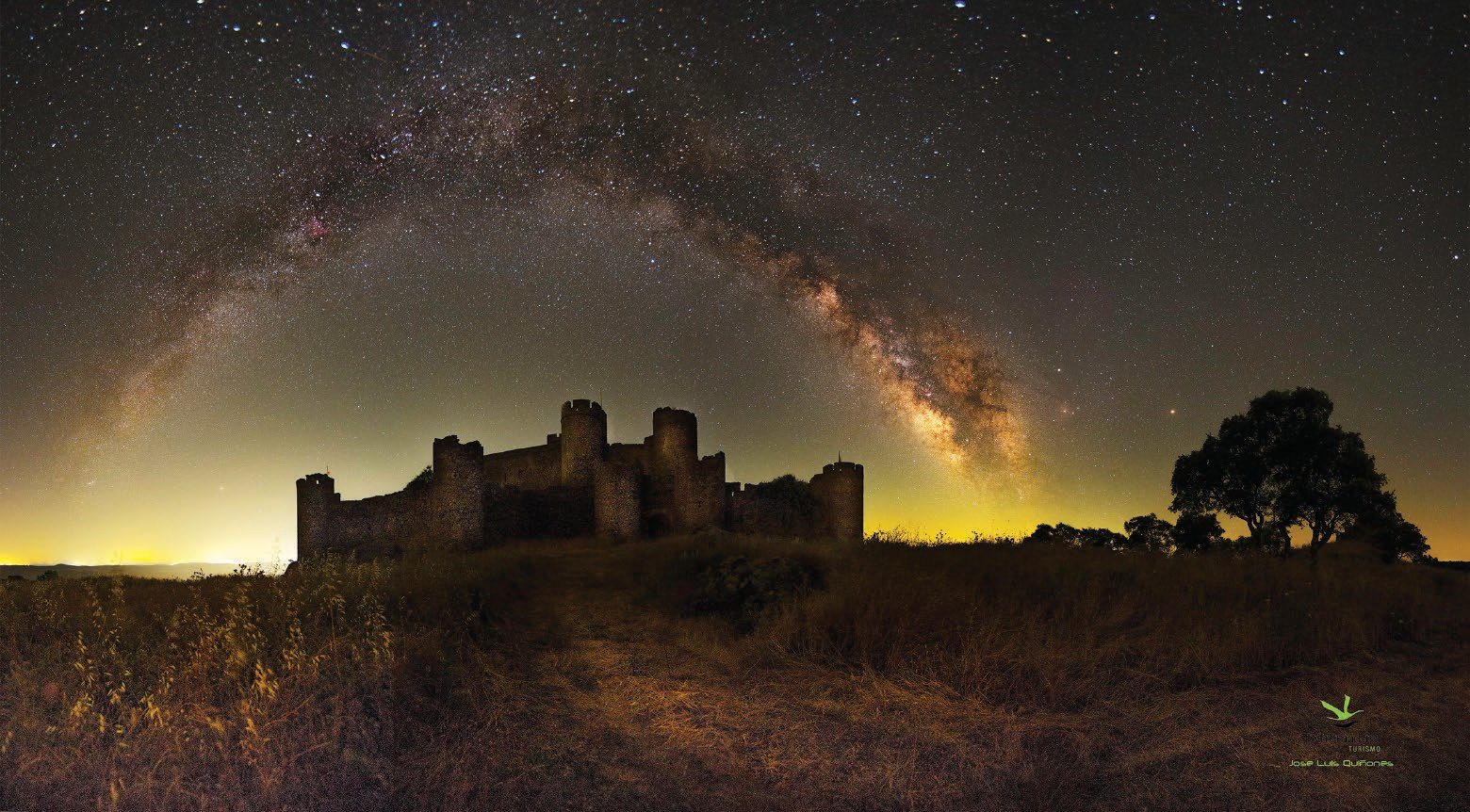
As we will discover, Spain has a well-kept secret: a network of out-of-the-way natural places where the full beauty of the night sky can be regularly appreciated and used as a magical canvas on which to paint your event picture.
There are many professionals in the fields of science, astronomy, physics, weather and climate research keen to meet and discuss related issues in a setting that resonates with and complements their professional interest.
Just as there is a growing ‘Blue’ ocean economy and a community that studies and works with it, the stars are also aligning for the night skies to welcome the MICE sector to commune and work with it.
Ad astra!
Pure Nature certainly strikes a chord with our industry, which strives to be as sustainable as possible. Iceland and Norway have won industry marketing awards in recent years, as well as a place in our hearts, for harnessing their Nature as a stunning backdrop and talking point for events. Spain is now at the forefront of a new journey into the stratosphere, offering event planners and delegates options to tap into the power and magic of the wide universe above.
We are now learning that a destination’s greatest attraction or venue needn’t always be a building. It could be a landscape after dark, or something special such as the windmills of Castilla-La Mancha framed in the night sky. Or an observatory amid some historic ruins lit by an array of bright stars.
Taking a closer telescopic tilt at some of Spain’s MICE ‘overheads’ – and I don’t mean the service charges or production costs – we can pick out a few of Spain’s destinations quietly mining this new seam for meetings business.
La Palma is a UNESCO Biosphere Reserve and the most north-westerly island of the Canary Islands. It is known for its dramatic volcanic landscapes and dark night skies. In 1988 the local authorities even brought in a law for the protection of the quality of the sky.
The Institute of Astrophysics of the Canary Islands (IAC) has its headquarters in La Palma at the Astrophysics Center, in Breña Baja, and at the Roque de los Muchachos Observatory, in the municipality of Garafía. Tours and astronomy workshops are available.
Another of the initiatives underway is the International Meeting of Researchers, to which a Walk of the Stars of Science has been dedicated, located on the avenue of Santa Cruz de La Palma. It was inaugurated by theoretical physicist Stephen Hawking. The island celebrates the stars, too, with film festivals such as the Festivalito La Palma, and the night races during the Transvulcania or the Reventón Trail, showing that the sky can also be a source of inspiration for sport, as well as art and science.
La Palma’s example is also an illustration of how protecting the night sky can itself become part of a destination’s MICE strategy and a calling card; a sort of rural version of the creative multi-year campaign that Madrid’s convention bureau pursued to turbo-charge sustainability in events with its PLUS programme (Platform for Legacy with US). That pioneering digital toolkit has helped drive many planners’ own sustainable event action plans. It also led to The Madrid Challenge: a joint commitment charter with the BestCities Global Alliance aimed at building lasting legacies and reducing environmental footprints across the international events industry.
Huesca and Aínsa/Boltaña in the Pyrenees also offer an interesting working event model allied to dark sky thinking: conferences during the day and astronomical observation at the castle at night. Ideal for that getaway from city life.
Many of this region’s picturesque villages, such as Alquézar, Aínsa, Benasque or Jaca, offer perfect dark skies for astronomical observation and quiet, rural authenticity.
The Huesca Astronomical Observatory offers guided tours and activities. And the Pyrenees peaks, glacial lakes and extensive forests make another perfect environment for stargazing in a secluded environment. One such place is the Parque Natural de los Cañones y la Sierra de Guara, with its spectacular karst relief and steep canyons. It offers stunning views from the rugged landscapes with no light pollution.
Cuenca is another interesting case. Its AstroCuenca association explicitly combines astronomy, observation, training and congress activity, and it hosted the 2026 ApEA (Association for the Teaching of Astronomy) meetings. The association has organised other major events, including the International Solar Congress (2008), the ApEA Meetings in 2009 and the 23rd CEA conference in 2018 – a congress with more than 300 participants held in collaboration with the Science Museum of Castilla-La Mancha.
The fusion of science and astronomy is facilitating sustainable tourism in the Province of Cáceres. Its AstroCáceres 2026 tourist programme involves night-sky observation blended with topics of Nature, heritage, history, mythology and gastronomy. Its incentive programme offer includes a choice of 14 different activities such as stargazing, legends and night walks.
And the town of Lalín is considered the birthplace of modern astronomical research in Galicia. Significant night sky observations have been conducted for well over a hundred years and the Starlight Tourist Destination certification was obtained in April 2023. Lalín hosted the 5th Professional-Amateur Astronomy Congress (PROAM) in May 2026, which incorporated astronomy, observatory visits and practical work measuring the brightness of the night sky. The congress was organised by the Spanish Astronomy Society (SEA) and the Federation of Astronomical Associations of Spain (FAAE). The core focus was promoting citizen science and shared data networks. Key themes of recent editions have focused heavily on national coordination for major solar eclipses (including the landmark August 2026 total eclipse), remote observatory automation, light pollution monitoring and sky-survey data classification.
La Palma’s tourism research has also already proven that destinations can embrace conferences and meetings alongside activities such as astrophotography, star parties, open-air talks, astronomy-themed gastronomy and night-sky experiences.
A typical corporate group could have a programme that would include a daytime conference, with workshop, leading on to an evening dinner and transfer to a dark-sky site, where there would be astronomers, telescopes and further drinks under the stars.
From such experiences delegates are able to return home with not only scientific and astronomical knowledge in their heads, but also a feelgood factor in their hearts, having temporarily detoxed from light and noise pollution.
For planners, events under the night skies also have the attraction of being low maintenance, with minimal infrastructural requirements.
So raise your eyes above the familiar and mundane and discover a whole new universe of opportunity and natural experience to take your event into a brave new world.