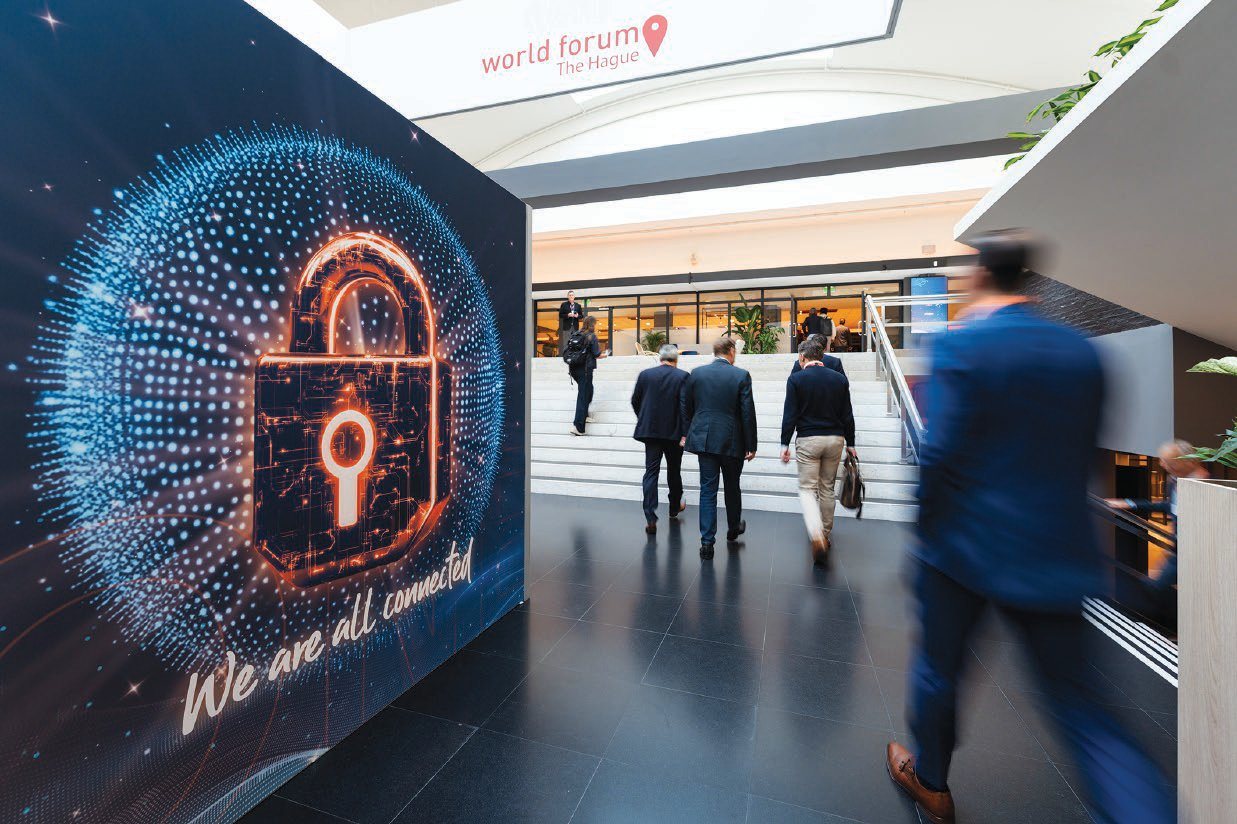
The World Forum The Hague has won a reputation for hosting some very important political and high-level economic conferences where heightened security is a big consideration.
The venue’s security credentials are such that, in recent times, World Forum The Hague (WFTH) has hosted:
1. The NATO Summit 2025 (24–25 June 2025)
This was the largest and most significant security operation ever hosted in the Netherlands. The event brought together 45 heads of state and government, along with foreign and defence ministers, 6,000 delegation members and 2,000 journalists.
The event involved 27,000 police personnel and 9,000 Marechaussee officers. It also required closing a major adjacent transit road for five months to construct 14,000sqm of highly secure temporary facilities.
2. The ONE Conference (annual, October)
One of Europe’s premier cybersecurity events, The ONE Conference is regularly held on the WFTH main stage. It brings together international government officials, economic leaders, law enforcement and researchers to address global digital threats, critical infrastructure protection and cyber warfare. Due to the attendance of high-ranking global intelligence and defence figures, the conference relies on strict access protocols – including identity vetting and specialised access control software such as NineID.
Running this November (15–19) is the ACM Conference on Computer and Communications Security (ACM CCS). This flagship annual conference for the Association for Computing Machinery’s Special Interest Group on Security, Audit and Control (SIGSAC) focuses on the latest developments in information security, privacy and cryptographic protocols.
Secure DNA
CMW asked general manager Michiel Middendorf, who has worked at the venue for 17 years, about security best practices, standards and policies and what it entails to maintain a high level of safety for all delegates and guests.
“At World Forum The Hague, security is part of our DNA. While our level of security has traditionally been associated with governmental and high-level political events, it is increasingly a requirement for international corporate events as well,” Michiel Middendorf says.
“Maintaining high standards in event security comes down to one key principle: training, training and more training. Our team receives regular training in areas such as crisis management, security awareness, cyber security awareness and active response to an armed attacker. For several of these areas, we work closely with local authorities to ensure that our approach is aligned and that our teams are well prepared to respond effectively in the event of an incident.
“Ultimately, security is also about awareness. Many incidents have been prevented simply because one individual was alert, observant and recognised that something was not quite right. That level of vigilance is an essential part of our security culture.”
Potential security threats are assessed, Michiel Middendorf explains, by offering clients a formal risk analysis during the event planning process. Based on the outcome, WFTH provides tailored recommendations on the appropriate security measures for the event. “The level of security is assessed according to the nature of the event, the profile of the delegates and any specific potential threats,” he notes.
He cites industry associations such as AIPC and ICCA as valuable sources of knowledge for venues, noting that while ICCA provides broader training and knowledge across the international association events sector, AIPC has a strong focus on venue management, keeping members informed about the latest developments and regulations in security and cyber security.
Creating peace of mind
In terms of working with organisers to ensure their events pass off as smoothly and safely as possible, Michiel Middendorf underlines that “security is the finest form of hospitality. Whether visible or discreet, security should give people a sense of safety and reassurance, rather than make them feel that something is wrong or that they are at risk.”
Good security at events creates peace of mind, he believes, and it should be present when needed but never create unnecessary tension or distract from the event experience. “We work closely with organisers to find the right balance.”
Terrorist threats and activity have prompted many countries to introduce stricter venue security obligations (such as Martyn’s Law in the UK). Here, Michiel Middendorf believes it is the role of a venue to stay ahead of legal obligations rather than simply respond to them.
“We believe that as venue managers, we have a responsibility to go beyond the minimum legal requirements. We do not want to wait for legislation to tell us what to do. Staying ahead means continuously assessing new risks and developments and, where necessary, adapting our procedures and operations accordingly.”
The GM adds that cyber security and physical security go hand in hand. “We see these two aspects as closely connected.
“To simplify: how cybersecure is a large LED screen on your building if anyone can physically access it? Or how secure is the firewall of your stand-alone Wi-Fi network if anyone can physically access the equipment and connect to it? Even the strongest digital security measures can be compromised if the physical barrier is not secure.”
His advice to organisers is to bring their own security expert to the site inspection and let them connect directly with the WFTH security team on site. “This,” says Michiel Middendorf, “allows potential security risks to be addressed from the start. At World Forum The Hague, we see security as a shared responsibility between the organiser and the venue, with both physical and cyber security considered as part of the overall event.”