Fáilte Ireland is now ready to share its new Green Toolkit for Business Events, designed to support Irish and international event organisers in planning and delivering more sustainable business events across the country.
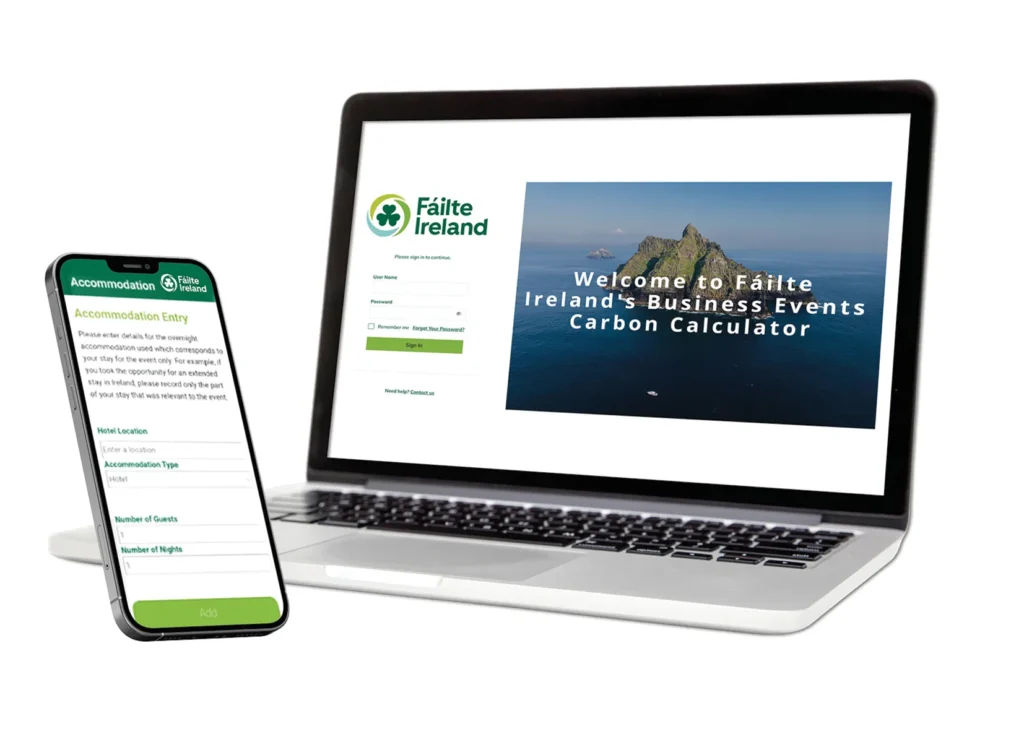
The toolkit provides a practical 7-Step Sustainable Event Roadmap, sustainability checklists, and case studies demonstrating best practice from recent conferences hosted in Ireland. It also includes guidance on avoiding greenwashing, as well as information about Fáilte Ireland supports such as the Business Events Carbon Calculator and the Destination Subvention Framework.
Available to download through the Fáilte Ireland Business Supports website, the toolkit aligns with Ireland’s business events strategy, Business Events 2030, and Ireland’s broader climate ambitions. It is intended for PCOs, event organisers, universities, associations, and international planners seeking to embed sustainability into their events.
The resource also provides further information on how environmental sustainability is linked to Ireland’s subvention framework – applicants who select sustainability criteria within their funding application will receive direct access to the toolkit and will be required to use the toolkit along with Fáilte Ireland’s Business Events Carbon Calculator.
Ireland’s sustainability credentials, combined with this new practical resource, ensure that business events hosted in Ireland can manage and reduce environmental impacts, while delivering long-term legacy impact.
A destination built on strong environmental management and adaptation credentials
The toolkit does not exist in isolation – it is underpinned by strong environmental credentials. The Irish government has a strong commitment to protect its natural landscapes and habitats including eight national parks, over 600 Natura 2000 sites protecting land and marine biodiversity, three UNESCO Global Geoparks, and 89 Blue Flag beaches. The country ranks second in Europe for wind and solar energy production per capita, and 100 per cent of Ireland’s convention centres have achieved environmental certification.
For planners evaluating destinations on sustainability grounds, Ireland’s five principal business event hubs – Dublin, Cork, Kerry, Galway, and the Shannon Region – all rank within the top 40 of the Global Destination Sustainability Index (GDS-Index). This internationally recognised benchmark assesses cities and regions on their environmental policies, carbon reduction efforts, circular economy initiatives, and community engagement.
Ireland’s business events sector includes a range of venues and destinations that participate in recognised sustainability certification schemes and benchmarking frameworks. These certifications and benchmarks provide structured and independently assessed indicators of sustainability performance. Examples include – the Convention Centre Dublin (CCD) is the world’s first carbon-neutral convention centre, and Dublin Airport has maintained carbon-neutral status since 2020. Dublin Bay holds UNESCO Biosphere designation – the only capital city biosphere in Europe. In Cork, over 70 per cent of hotels hold sustainability certification, whilst Clare is home to Ireland’s first GSTC-certified sustainable tourism destination and the first carbon-neutral, B-Corp certified hotels in the country. Kerry, meanwhile, holds Ireland’s first International UNESCO Dark Sky Reserve and is home to the longest section of the Wild Atlantic Way.
Aligning with international sustainability frameworks
Fáilte Ireland’s ambition extends well beyond destination marketing. As part of the UN SDG Ambassadors Programme, led by the Department of Climate, Energy and the Environment, Fáilte Ireland serves as an official ambassador for advancing the United Nations Sustainable Development Goals across tourism. Its four core contributions are advocacy – promoting awareness and adoption of the SDGs across the tourism sector; support – assisting businesses in implementing sustainable practices; integration — aligning strategic programmes and initiatives with the SDGs; and vision – positioning Ireland as one of Europe’s most sustainable tourism destinations.
For the business events sector specifically, Fáilte Ireland’s work aligns with seven SDGs: Decent Work and Economic Growth (SDG 8), Industry, Innovation and Infrastructure (SDG 9), Reduced Inequalities (SDG 10), Sustainable Cities and Communities (SDG 11), Responsible Consumption and Production (SDG 12), Climate Action (SDG 13), and Partnerships for the Goals (SDG 17). These goals are not aspirational – they are embedded into Business Events 2030 and operationalised through Fáilte Ireland’s practical supports and funding frameworks.
Business Events 2030 was developed collaboratively with Fáilte Ireland, the Department of Enterprise, Tourism and Employment, Tourism Ireland, and industry leaders. It represents a fundamental shift in how Ireland approaches the sector – one rooted in sustainable development, taking full account of current and future economic, social, and environmental impacts. The strategy’s ambition is clear: to make Ireland not merely a destination of choice, but a destination of conscience for business events worldwide.

From footprint to handprint: Leaving a lasting legacy
One of the most compelling ideas within the toolkit is the concept of the event ‘handprint’ – the positive legacy an event actively generates, as distinct from the environmental footprint it leaves behind. Whilst reducing travel emissions, eliminating single-use plastics, and lowering venue energy consumption remain essential, Ireland’s leading events are going further: funding biodiversity projects, partnering with social enterprises, using hyper-local suppliers, and piloting circular models that benefit the wider community long after delegates have departed.
Recent events hosted in Ireland demonstrate what this looks like in practice. The 35th International Geographical Congress, held at Dublin City University in August 2024, engaged almost 300 members of the public through events including a ‘City Climate Walk’, and raised funds through an optional environmental levy to support carbon insetting on Irish university campuses as a legacy project. The 2022 Atlas International Tourism Conference in Cork aligned its programme to Cork City’s own SDG commitments, introduced a ‘Leave No Waste’ charter, and established a new ‘Inclusive Access to Education’ programme as a direct conference output – a tangible example of how regionally anchored sustainability ambitions can shape internationally impactful events.
Fáilte Ireland’s own flagship trade event, Meitheal, has become a live model for how the 7-Step Sustainable Event Roadmap can be applied, with food and beverage sourced locally, carbon footprint measured using the Business Events Carbon Calculator, and post-event sustainability reporting built into its commitment cycle. It is precisely this culture of evidence-based, improvement-focused sustainability that the Green Toolkit is designed to spread across Ireland’s business events industry.
Download the toolkit:
https://supports.failteireland.ie/irelands-green-toolkit-for-business-events/
For further information contact: SustainableImpactTeam@failteireland.ie