“Stability, alignment, reassurance are no longer background considerations but foreground criteria”
There are moments in our industry when the numbers don’t just inform – they hum, like a low note on a well-tuned guitar, telling you something has shifted beneath your feet. The latest SITE Pulse Survey, conducted in late March and early April, is one of those moments. It doesn’t shout disruption; it traces its outline, quietly but unmistakably.
At first glance, the story appears straightforward: geopolitical instability, particularly in and around the Middle East, is influencing destination choice. But linger a little longer with the data and something more nuanced emerges – a recalibration of confidence, a subtle re-drawing of the incentive travel map in real time.
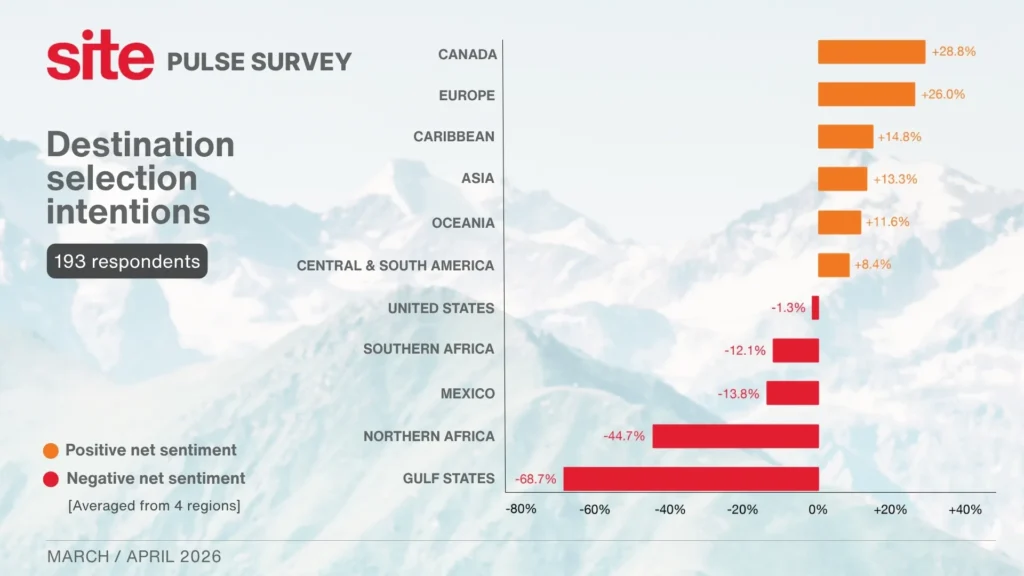
Take the Gulf States, where sentiment has fallen sharply across all major source markets. Among US respondents, the net sentiment score drops to a stark -82%, mirrored by similarly negative views in Europe and beyond. This is a decisive turning away, driven less by logistics than by perception – the emotional temperature of a destination as much as its physical reality.
And yet, as one door closes, others open.
Canada emerges, almost unexpectedly, as the quiet beneficiary of this moment, posting strong positive sentiment across multiple regions – +66.7% among European respondents and +46.4% from the Rest of World cohort. The Mark Carney effect? Maybe.
Europe, too, holds its ground, even strengthens it, with intra-regional confidence reinforcing its appeal.
Incentive travel planners are not cancelling; they are recalibrating. The instinct remains: to gather, to reward, to create moments that matter. But the lens through which destinations are viewed has sharpened. Stability, alignment, reassurance: these are no longer background considerations but foreground criteria.
There is, too, a fascinating divergence in perception depending on where you stand. The United States, for example, remains positive among its own domestic planners, yet registers a net negative among every non-US cohort.
And here lies the deeper truth, one that those of us in incentive travel have always sensed but rarely seen expressed so clearly in data: this is an industry that lives at the intersection of the rational and the emotional.
Programmes are built on budgets, logistics, and ROI but they are chosen, ultimately, on how a place feels. Safe, aspirational, welcoming, aligned. In times of uncertainty, that emotional register becomes amplified. Destinations that can articulate not just what they offer, but how they resonate, will find themselves ahead of the curve.
The Pulse Survey is a signal. It tells destinations and DMCs where the wind is blowing, but more importantly, it suggests how quickly it can change. Agility, clarity of positioning, and a deep understanding of client sentiment are no longer nice-to-haves, they are essential.
Because if there is one consistent thread running through these findings, it is resilience.
Milestones
Two important milestones underscore SITE’s continued commitment to insight and evolution. The survey instrument for the Incentive Travel Index 2026 will be launched at IMEX Frankfurt, marking the next phase in the industry’s most authoritative longitudinal study.
Alongside this, new research conducted jointly by Maritz and SITE, with support from Hilton and the SITE Foundation, will be released offering a new take on generational attitudes to incentive travel rewards, and how motivation itself is evolving in a changing world.