Most conferences end with a delegate count and an economic impact figure. The International Social Housing Festival (ISHF) 2025 ended with a report, and that offers a guide and template for future positive action.
Fáilte Ireland, the National Tourism Development Authority of Ireland, published its first intentional impact report on a business event, covering ISHF Dublin 2025. The festival, an initiative of Housing Europe, was hosted by the Irish Council for Social Housing (ICSH) at the Convention Centre Dublin, 4–6 June 2025. It drew 2,348 delegates from 48 countries across five continents and generated an estimated €3m for the city.
Those numbers are familiar territory and demonstrate significant economic impact. But what sets the report apart is everything else: a structured ambition to show what an association conference changed for its host community, its sector and its destination – and how that change was measured. That work is now, also, a powerful guide to future action. ISHF was Fáilte Ireland’s first intentional impact pilot.
Paul Mockler, head of business, festivals and major sports events at Fáilte Ireland, writes in the report’s foreword that the festival “showcased how business events can serve as catalysts for social change”. He adds that the report highlights “the opportunity to embed social impact into how we attract, deliver, and evaluate association conferences in Ireland.”
The work was, importantly, a partnership. Fáilte Ireland worked with the Irish Council for Social Housing (ICSH), PCO Conference Partners International (CPI) and Housing Europe. As a central focus of the impact project, the ICSH sought to incorporate the voices of tenants in Ireland into ISHF 2025 by embracing the concept of “not about us without us”, aligning with the festival’s theme of ‘Storytelling’.
Before the event, a broad stakeholder group co-created a Theory of Change – a framework that maps each activity to short-, medium- and long-term outcomes. Two impact pathways were chosen: tenant empowerment, and strengthening the housing ecosystem. These ran alongside a main programme of policy dialogues with Irish and European ministers, site visits to Dublin housing developments, and cultural events across several venues.
Evaluation drew on a post-event survey of 270 respondents, semi-structured interviews with 11 domestic and international stakeholders, and partner documentation. The report notes the approach “moved deliberately beyond satisfaction metrics”, focusing on how the event generated value rather than how much delegates enjoyed it.
Tenants at the front door
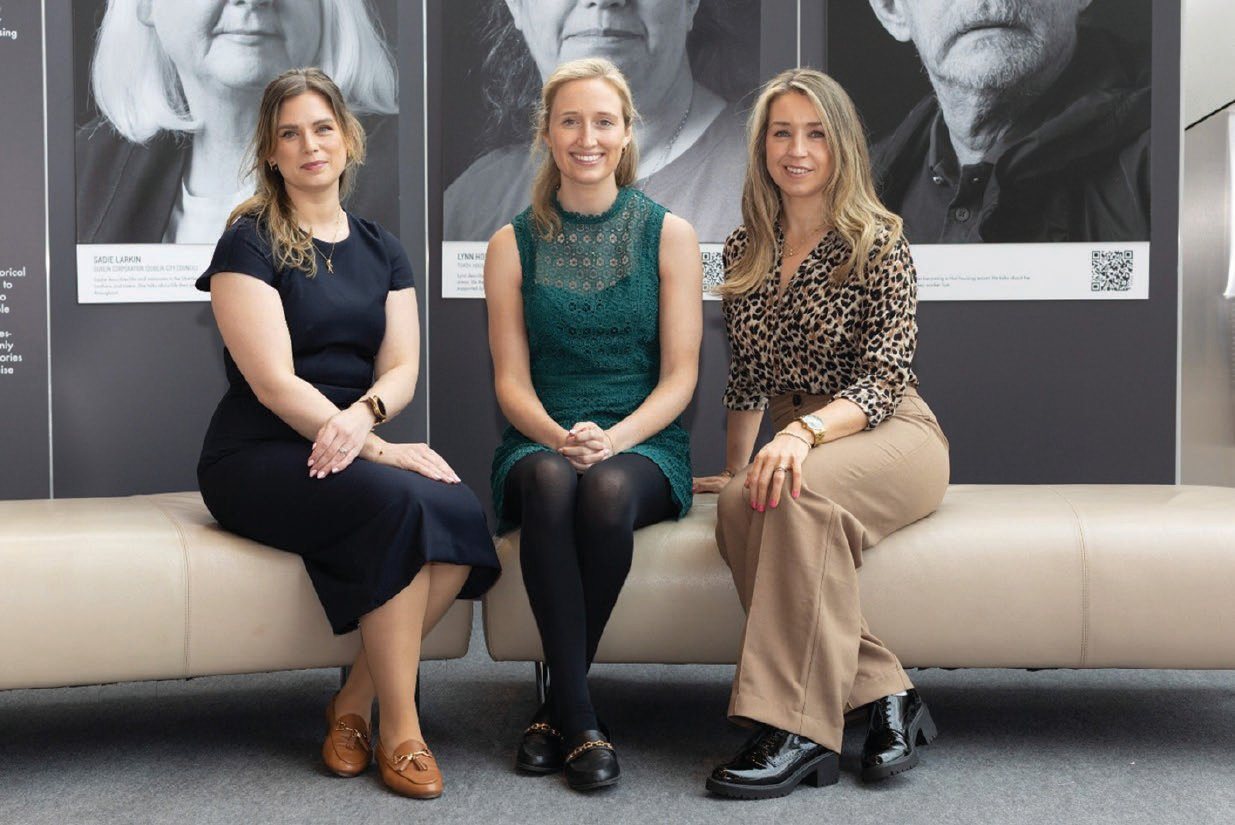
The first aim of the project, tenant empowerment, centred on an oral history exhibition showcased at the entrance of the Convention Centre Dublin. Titled ‘From House to Home’, it featured six social housing tenants sharing their experiences through portraits and audio, under the principle of “not about us without us”. Their recordings were also played at the festival opening ceremony to more than 1,000 delegates.
The report tracks reach as well as reaction. The exhibition webpage recorded 2,333 visits during and after the festival. An Oral History Toolkit, built so others can collect similar stories, has been downloaded 178 times. Delegates rated how meaningfully the exhibition shared tenant experiences at an average of four out of five.
Interviewees described the exhibition as “eye-opening” and “grounding”.
One delegate said: “Projects like this help embed tenant-first thinking… hearing lived experience helps design better services.”
Another said: “It’s fantastic because it’s the tenants speaking for themselves… it reminds people that it’s not just about the houses, it’s about their homes and families.”
The assets have kept working since the exhibition closed. The ICSH reused them at its National Housing Conference in October 2025 and at the Northern Ireland Federation of Housing Associations (NIFHA) conference in November 2025. Housing Europe now plans a “living library” of tenant stories from across Europe.
For planners, that is a point worth noting. Content designed for a single congress has now become a touring asset, extending the event’s reach well beyond its two and a half days.
A breakfast with measurable results
The second aim, ‘Strengthening the Housing Ecosystem’, was smaller in scale, but arguably the more transferable model. The ICSH and Fingal County Council hosted a Knowledge Network Breakfast on collaborative housing delivery, built around a Fingal case study. Thirty-five stakeholders from 24 organisations took part. Fingal’s development agreement drew particular attention, with one respondent calling it “an excellent model to base future developments on”.
Every survey respondent found the session interesting and useful, and everyone said they had gained new knowledge. Some 92% met people who could help them adopt more collaborative models, and the same share planned to stay in touch with two or more contacts. One participant said: “This was one of the best moderated forums I have attended.”
The lesson is a practical one. A focused side session with a defined goal and a short follow-up survey can produce harder evidence than a main programme often does.
What comes next
As ISHF moves to Lisbon in 2027, the oral history exhibition will travel onwards and an oral history toolkit will be shared, extending Dublin’s legacy and enabling future host cities to build on its impact. In doing so, the initiative will continue to influence housing discussions across Housing Europe member countries and beyond.
The Dublin model offers a sequence others can follow. Agree an impact intention with stakeholders before the event. Design specific activities to deliver it. Measure against it afterwards, and publish the results.