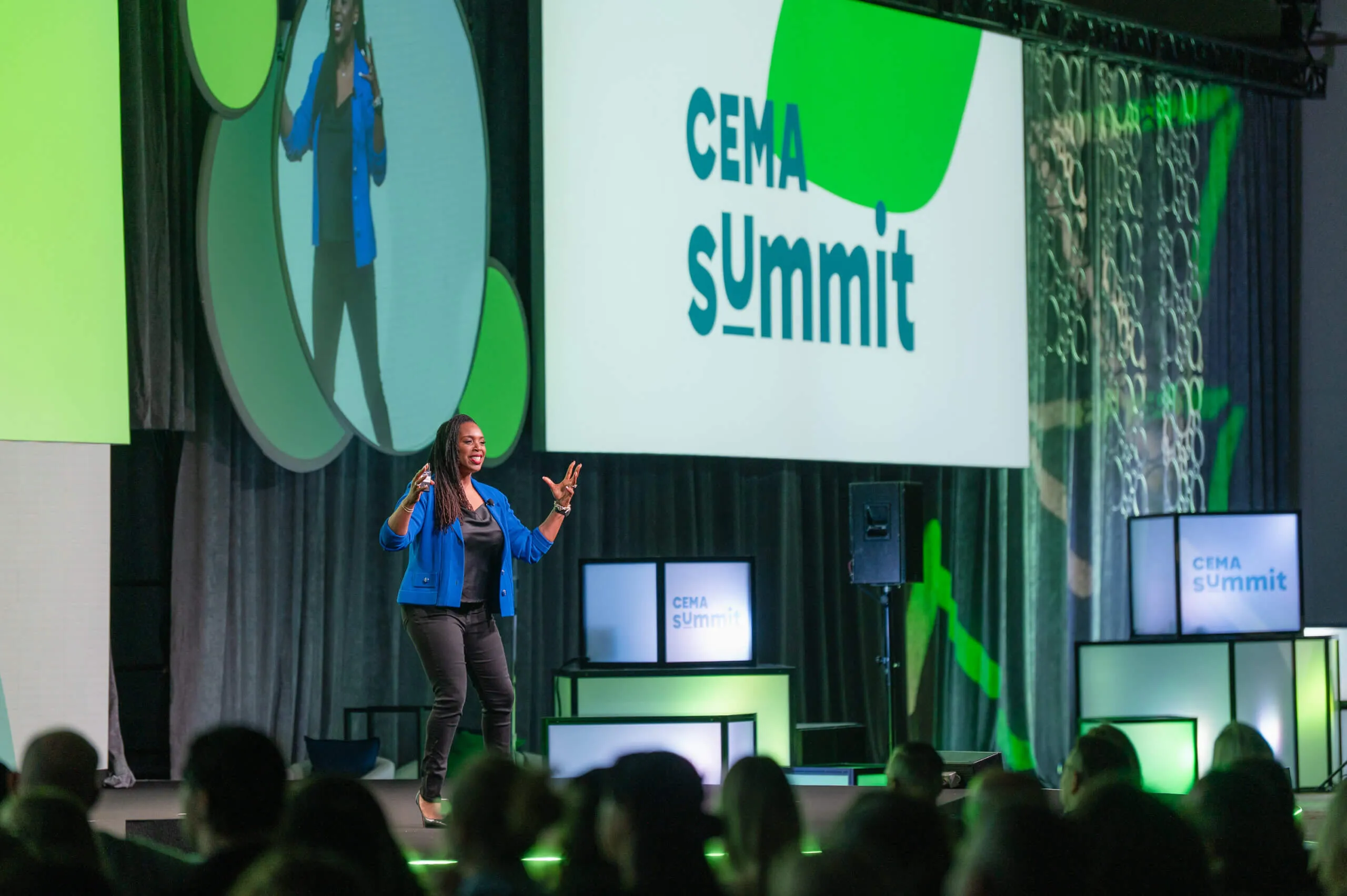
Speaker and emcee, Holly Ransom, who hosted the recent PCMA Convening Leaders gathering in San Diego, shares her philosophy of effective engagement and leadership:
Holly Ransom’s journey into public speaking began at a young age when she was involved in non-profit projects. She won an international award at a microfinance project in Kenya and was also, for a time, the world’s youngest Rotary president.
“I found myself sharing stories and strategy and had a real knack for sharing ideas in a way that helps other people learn and improve and apply their own capability to tackle problems.”
Then came the step into a corporate setting.
She says she fell into keynoting, including an early appearance alongside Sir Richard Branson when he was in Australia, and the Virgin founder subsequently asked her to come to London and host Virgin Disruptors. “Sir Richard really took me into the world of hosting and emceeing,” she recalls.
Ransom went on to work with many CEOs, carving out a reputation as ‘a different thinker’. It was an experience, she says, that made her also aware of her blind spots and to think more deeply about inter-generational engagement and different ways of approaching a problem.
Ransom also founded Canada’s eminent energy summit about energy disruptors where she developed her passion for creating ‘collisions of unlike minds’ in order to create incredible experiences.
Hosting for PCMA
“Hosting PCMA has been incredible,” she says. It is a job that is already six years and counting. Ransom clearly feels part of the PCMA Convening Leaders family and says the experience of curating at PCMA has equipped her to deal with people from across a variety of geographies who face very different challenges when creating their business events. They are events created against varied backdrops of regulatory realities and government responses.
One of her philosophies is the power to “truly listen, reflect and join dots and make meaning of new information.”
If we don’t do that, she says, we aren’t closing what she calls ‘the knowing and doing gap’. “We do a lot of knowing and we don’t do much doing, because in reality we’re not creating the space for ourselves, the white space, to be able to reflect on information that we’re taking in and apply it.”
Ransom explains her PCMA work is all about building community. “My lens,” she says, “always comes from deeply understanding my audience. This entails considering what might they be challenged by.
“Sometimes you’re interviewing people where it could be easy for them to say, ‘Fine for you to say that. But you’re not in my kitchen feeling my heat. So, how can you tease out some of those objections and assumptions?’”
She believes we’ve historically underestimated the role of place in the design of our events and talks about taking people out of a ‘habit loop’.
Ransom talks about interrupting mental patterns that can lead to a very different set of conversations and advocates planners thinking more deeply about the role of music and experience, and about place in events.
Recalling her work on disrupting North American energy conferences, Ransom talks about a landscape that was very siloed. “You would have oil and gas meeting at their conference, the renewables conference meeting, and a solar meeting at one place and a geothermal meeting somewhere else, and nuclear in yet another location. The energy transition doesn’t happen if we continue to sit in these siloed conversations. We thought about how we bring everyone together and create a really cross sectoral dialogue. Also, we talked about the need to inject some people into this sector whose perspectives could be invaluable, and who probably hadn’t been heard from.”
She lists such people as Erin Brockovich on people power; Adam Grant on how we need to think again, and Richard Branson on entrepreneurship and smart risk taking – all powerful outside voices and challenging external thinkers.
Ransom says she likes to see a ‘healthy tension’ in planning but notes the importance of being really clear around what’s most important to achieve in terms of prioritisation, and making sure the focus is on investment in those areas.
“Make sure you have an innovation budget,” she adds.
Challenge yourself
Disruptive strategy, for Ransom, includes the opportunity to actively challenge yourself. If we see things being incapable of being challenged it speaks to a brittleness, she believes, saying we need to keep retesting our base case.
“We typically underestimate as businesses the disruption that’s going to come from within our own industry, and assume it’s coming from outside,” she adds, and urges leaders to be open to the challenge of creating an environment and culture of questioning.
They should, she says, want to be on the front foot in driving their own direction or their response to what’s going on in the market.
Embracing discomfort
“Building a habit of getting comfortable being uncomfortable is arguably the single most important thing leaders can be doing and cultivating as part of their culture in their team in this current day and age,” says Ransom. “Leaders who can build the muscle of their change resiliency, that ability to embrace discomfort, have a competitive advantage moving forward.”
Good leadership, she believes, means breaking things down into bite sized pieces and working in a way that encourages consistency, “because that’s the way we build a habit and build a muscle”.
Reducing anxiety and stress means having the self awareness and the understanding of what works for you, Ransom believes. “It begins by asking yourself the question, ‘What is it that gives me energy? What is it that allows me to come down from the adrenaline high or the intensity of an event? Some people use breath work, some use mindfulness activities, others get out in nature; the important thing is to know what works for you and then to be really clear about the systems that you’re using to support yourself to do it consistently,” she says.
The reality is in high stress demanding worlds, she says, we can never find the perfect 20 minutes to meditate or 30 minutes to go to the gym, or whatever your tools for distressing are. We need to challenge ourselves to break it down to a three-minute version. “Leaders should be really mindful of being visible about doing this and this gives permission for your team to do the same,” she says.
Digitisation
With increasing digitisation, how does Ransom you see the future of business events evolving?
She sees technology being more and more involved in every facet of our event design.
“We’re seeing the idea that events can both start earlier and finish later. I like what Priya Parker talks about in terms of seeing the start of your event is the moment you receive an invitation. I see there being an elongation of the event experience, I see there being the opportunity to support the ideas that are shared at events, turning into outcomes more regularly.”
It is important, she adds, that people are able to go back to work the next day, and actually embed the ideas.
Staying ahead of the curve
Staying ahead of the curve in terms of industry trends and insights is another core competency of leaders, for Ransom, who argues that comes from having a range of people in your network – a kind of ‘personal advisory board’, as she puts it.
Another important factor to note is the quantity of data points obtained at events which make for an interesting look at patterns and helps you to notice trends, she says and welcomes what she terms this ‘peripheral vision’.
Ransom encourages leaders to think about the way they are learning and work on themselves because that work is never done, she believes.
“All the great leaders that I’ve worked with and interviewed over my career are living examples of that. They’re still curious, they’re still practising, they’re still finding ways to challenge themselves, they don’t ‘arrive’.