There is much development afoot in the host city of this year’s AIPC annual congress. CMW looks at what’s in store for event planners in Boston
It is difficult to introduce the US city of Boston and not include its most beloved son, John Fitzgerald Kennedy. The 35th US President’s short-lived tenure ended in tragedy but his legacy, certainly for Greater Boston, is present in all aspects of city life.
Born in Brookline, Greater Boston’s most celebrated son achieved a great deal during his three years in power. Information on his campaigning for civil rights, nuclear disarmament and the space race is accessible throughout many of the city’s tourism destinations, but may be explored in greatest depth at the John F. Kennedy Presidential Library and Museum. For meeting planners, the venue can host events in five separate spaces available for rental: Smith Hall, the Dave Powers Room and the Atlantic Room all in the Stephen Smith Center; the Museum Pavilion and the Library Grounds.
The Kennedy Library can be used to accommodate groups of up to 1,000 guests for standing receptions only, and utilises both Smith Hall and the Museum Pavilion. They must be used with a flat rate for for 600 to 700 guests, and an additional charge for every person in excess of this number.
The Museum Pavilion makes for a striking setting for dinners and receptions, courtesy of a 115 foot-high glass wall that offers spectacular, panoramic views of Boston Harbour and the seas that held such appeal to Kennedy.
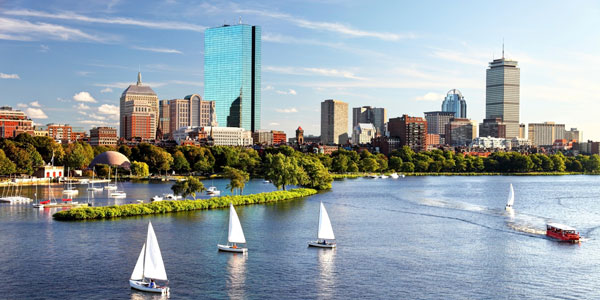
The North Atlantic coastline that surrounds Boston adds much to its allure, certainly as you come in to land at Logan International Airport. Boston Harbour is always busy with leisure and commercial traffic, and perfectly complements the activity taking place on the city’s terra firma.
While some cities are defined by their skylines, or cuisine, Boston is distinguished by the diversity resulting from its varied and vibrant neighborhoods. The city’s culture changes with each neighborhood’s personality and distinct appeal shifting the visitor’s impression of this historic capital’s appeal. The city’s immigrants have over the years brought many cultural enclaves to native Bostonians to make Boston the world-class city it is today.
The varied experience attributable to the city’s 14 neighbourhoods ranges from Fenway, home to the hallowed grounds of the Boston Red Sox, to Back Bay and Beacon Hill.
The latter is one of Boston’s oldest communities, taking its name from a beacon that once stood atop its hill to warn locals about foreign invasion. One square mile in size, Beacon Hill is home to the Massachusetts State House and America’s first African Meeting House, as well as notable figures including, including Oliver Wendell Holmes, Sylvia Plath and Senator John Kerry.
However it is the development in South Boston, once a predominantly Irish Catholic community, that is undergoing the most impressive development for global meeting planners today.
Home to ‘Southie Pride’ and the world-famous annual South Boston St. Patrick’s Day Parade, today the breathtaking South Boston Waterfront is emerging as Boston’s most dynamic neighbourhood. Home of the Boston Convention and Exhibition Center (BCEC), there is a great deal of development planned for the Waterfront that extends beyond new restaurants and hotels. The Institute for Contemporary Art, which opened in September, stands as an iconic symbol of the South Boston Waterfront’s potential.
“The BCEC and Institute of Contemporary Art are located here on the South Boston Waterfront,” Massachusetts Convention Center Authority’s Fred Peterson tells CMW. “If you look at the infrastructure put in place – the big dig – well, talk about development: US$16bn of investment, both on interstate and public transit. Combine the big dig and the BCEC, and you start to see the waterfront transforming on a grand scale.”
Not bad for a place formerly recognised as Boston’s largest riverside sewage dump.
Further congress space can be found at the Hynes Convention Center, which hosted this year’s AIPC Annual Conference.
The venue is part of a huge inter-connected complex that includes retail malls at the Prudential Center and Copley Place, fringed by the Sheraton Boston and Westin Copley Place Boston.
The congress venues have totally different design; Hynes is a historical contrast with the iconic BCEC.
Events are also hosted at the Museum of Fine Arts in the Fenway area, and performing arts venue the Wang Centre.
The TD Garden sports and entertainment arena, home to the NHL’s Boston Bruins and NBA’s Boston Celtics, is currently in the throes of major renovation, and offers many suites for corporate entertaining. The venue was home to the Democratic National Convention in 2004.
Academic facilities are also in abundance, not least courtesy of the Ivy League university Harvard, another of the city’s leading attractions and an on-tap resource for event speakers.
“As people visit it’s a natural draw,” says Peterson. “But if you look at the key areas: life sciences, educational, finance, technology, it’s all tied in neatly to a lot of our conventions. For conference planners, you don’t have to fly your speakers in, they can just ‘take the T’ (Boston Elevated Railway) because your keynote speakers are right here, at Harvard.”
And it follows that industry is in-step with such a significant institution. Biotech companies are here: Vertex Pharmaceuticals is based on the South Boston Waterfront, and Biogen and Genzyme are also in the city. Financial services provider State Street and PWC have Boston bases. Further corporate investment, both new and longstanding, is another of the city’s defining characterstics.
“The rich history is something a lot of people know about Boston but what’s interesting is that you still have these historic neighbourhoods but there’s a lot of gentrification now,” another spokesman for Greater Boston Convention & Visitors Bureau told CMW. “A mix of the old and the new, today you have a lot of millennials moving in. And when they come in they demand different things – as a result you start to see old neighbourhoods with fun new attractions.”
There are few places in the US that have seen such rapid growth.
Today Boston prides itself on being a leader in the area of community engagement, maintaining active connections between business, academic and professional communities. Which brings us back to another of JFK’s celebrated achievements, the establishment of the Peace Corps. Conceived to help people outside the US understand American culture – and for Americans to understand the cultures of other countries – this initiative perfectly demonstrates one of the core values of the global meetings industry – cultural appreciation and collaboration.
Boston stands as manifestation of this initiative and for international visitors, offers an event destination imbued with a sentiment of universal empathy – a wonderful place to do business.