Catie Owen examines the potential impact of Apple’s Vision Pro on the events industry. Ten years after the lukewarm launch of Google Glass (Google’s forsaken ‘smart glasses’), Apple announced the 2024 launch of its Vision Pro ‘spatial computer’ at the company’s 2023 Worldwide Developer Conference in June. The Vision Pro is set to run its own newly developed operating system, visionOS, to render augmented reality (AR) and virtual reality (VR) versions of Apple’s apps such as Facetime – found through the product’s new App Store. With the new Store comes a host of new tools for Apple’s developer community to use, possibly heralding an incoming revolution for event tech. At the Conference, Apple CEO Tim Cook said: “Today marks the beginning of a new era for computing.” As an industry constantly looking to improve upon its virtual and hybrid options, it’s worth considering the impact of wearable technology on events. Is it the solution to the community-building barrier between in-person and virtual we’ve all been looking for? Mike Rockwell, Apple’s VP of the Technology Development Group, said: “Through a tight integration of hardware and software, we designed a standalone spatial computer in a compact wearable form factor that is the most advanced personal electronics device ever.” Which indicates that users could potentially join a virtual event from the comfort of their living room. The combination of AR and VR builds a 360° version of the event around the wearer, which could re-create the in-person attendee experience. For delegates who are limited due to location or accessibility, this could be a game changer. Apple has already confirmed the use of Facetime on the device when it rolls out in the US next year, so it follows that Zoom, Teams, and more won’t be far behind. The Vision Pro might also be a useful tool for event planners. With the world having gone remote, teams globally rely on video conferencing software. The inevitable adoption of video conferencing apps on the Vision Pro could add an immersive aspect to the event planning process. How long until we’re scrolling through floor plans and analytics Minority Report style?
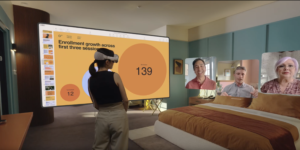
The combination of AR and VR builds a 360⁰ version of the event around the wearer