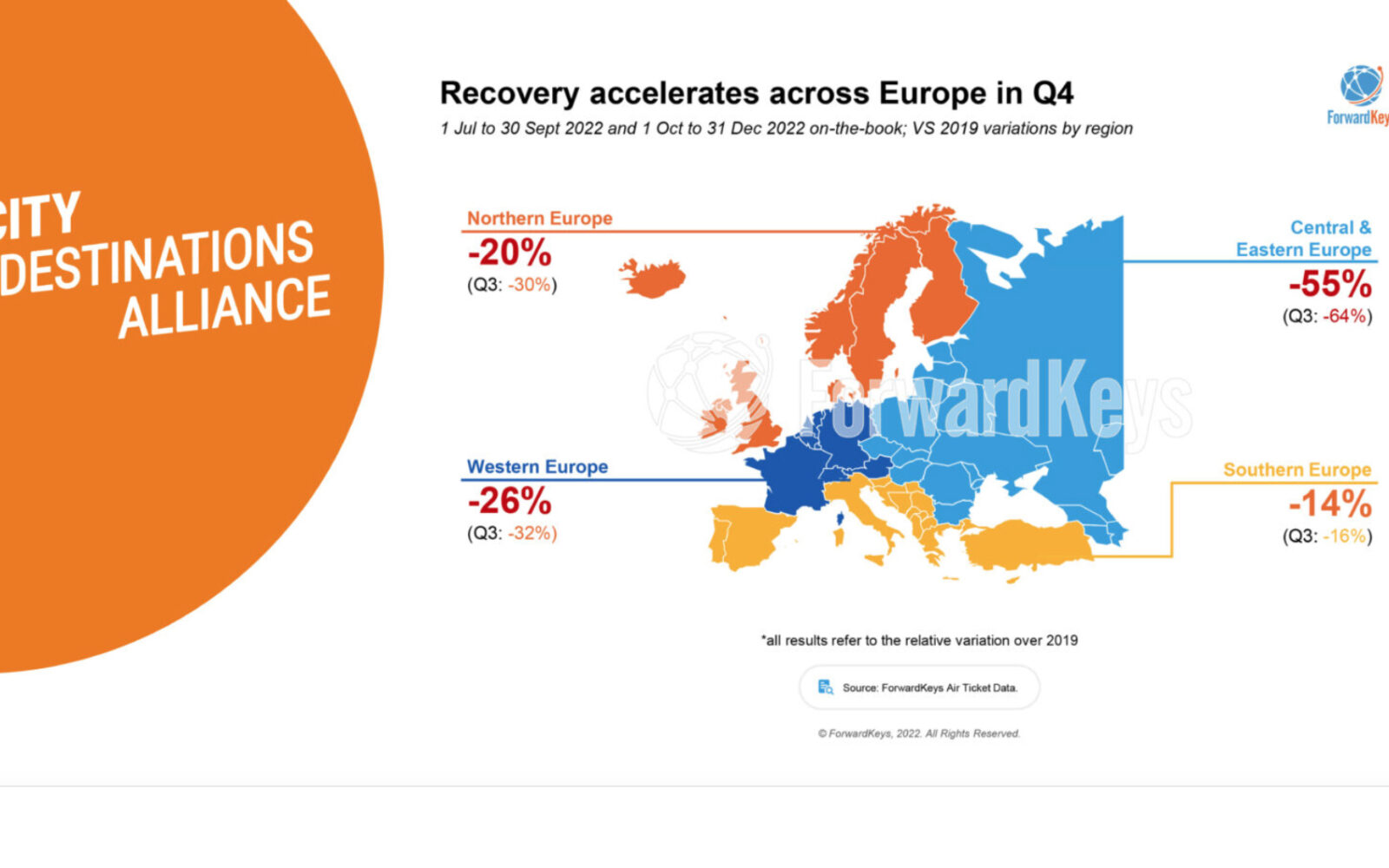
Analysis by travel analytics firm ForwardKeys has revealed at the Annual CEO Meeting of Capital and Major Cities by CityDNA, that the latest air ticketing data show European cities on track to recovery in Q4. While international travel recovery worldwide in Q4 tracks 30% below 2019 levels, the European continent is overperforming the world average at -24%. This also represents an acceleration compared with the -30% registered in Europe in Q3. Southern Europe is leading the way (at -14% in international arrivals), although other parts of the continent are catching up: Northern Europe (-20%), Western Europe (-26%) and Central and Eastern Europe (-55%). “On the flip side, the performances of Central and Eastern Europe are still negatively affected by the war in Ukraine, which is impacting not only on the countries directly involved but also on neighbouring destinations,” says Olivier Ponti, VP of Insights at ForwardKeys. The CityDNA City index, which compounds information on European cities, has registered a 23% decrease in international arrivals in Q4, in line with the European average of -24%. In the last quarter of 2022, London (-23% in international arrivals), Paris (-18%) and Istanbul (+9%), register the highest number of international arrivals, a clear sign that international travellers are finding their way back to Europe’s larger metropolises. “The good results of Istanbul have been made possible by a rapid expansion of the destination’s air connectivity, a weak lira and a steady ‘open for business’ policy. Compared with 2019, Istanbul registers 6% more seats on international flights,” adds Ponti. When looking ahead at the 2023 outlook, Q1 in Europe is off to a good start as well at just -20% international arrivals compared to 2019 levels. “The sustained recovery of international travel to European cities is very encouraging to see, after all the challenges our members have endured in the past years. The return of travellers to our destinations puts international co-operation and sustainability at the centre of our strategy,” says the president of City Destinations Alliance, Petra Stušek. “We, and our Destinations Management Organisations (DMOs) members, are strongly committed to rebuilding tourism and making our destinations achieve an even higher quality of life and better possibilities for employment,” adds Stušek.
European city tourism on track to recovery in Q4 2022
Comments
Comments are closed on this post.
Trending
Beyond attendance: How conferences can grow membership, strengthen communities and create lasting impact
1 week ago
IMEX America achieves top neurodivergent inclusive event design endorsement
4 days ago
Nearly 9 in 10 destinations improve as Helsinki leads 2026 GDS-Index
1 week ago
PCMA members approve 2027 Board of Directors and Trustees slate
1 week ago
Cairns doctor launches skin cancer conference, with a day on the Great Barrier Reef
3 days ago
Antwerp welcomes OpenLivingLab Days 2026
1 week ago
Major NZ healthcare conference chooses Hamilton for next phase of growth
1 week ago
Advertisement
Essential Reads

New EIC study finds business events contribute US$1.8 trillion to global GDP
Analysis

Washington DC bucks trend of US tourism decline with record visitor spending
North America

A look back at November’s IBTM and how event formats are “festivalising”
IBTMWorld

US airports face potential closures amid government shutdown
Business Travel

The countries with the highest business travel spend in the world
Business Travel
More like this