Samantha Glass, director of corporate affairs, Communication and Sustainability for ICC Sydney dives into the organisation’s new Accessible and Inclusive Events Guide and other initiatives.
What will the Accessible and Inclusive Events Guide do for ICC Sydney, and how important is this information for event organisers?
Our Accessible and Inclusive Events Guide expands the focus of our Diversity, Equity and Inclusion Strategy from our own people to encompass everyone who walks through our doors. By providing helpful tips for event planners, we’re hoping all the events and activities we host at ICC Sydney will be as welcoming as we aim to be. The Guide itself breaks down topics such as language and inclusion, accessible presentations, inclusive marketing, and communications, supporting those with hidden disabilities and the range of accessible and inclusive venue amenities at ICC Sydney. It is increasingly important for event organisers to be thinking about how to create truly accessible events as we know 1.3b people worldwide experience a disability today, with one in five Australians identifying as having a disability. Preparing and implementing accommodations for an inclusive event enables planners to unlock their potential to reach more people than previously possible.
Can you tell us about ICC Sydney’s sustainable practices and initiatives?
Sustainability is deeply embedded into ICC Sydney’s practices and has been factored into our venue’s design and our team’s operations even before we opened in December 2016. Our venue is part of the first precinct to be awarded the highest accolade of six stars under the Green Building of Australia’s Green Star Communities certification and is Gold LEED (Leadership in Energy and Environmental Design) rated by the U.S. Green Building Council. Furthermore, ICC Sydney has implemented environmental sustainability systems in line with international standards ISO14001 and EarthCheck criteria. We target 75% operational waste diversion from landfill with large back-of-house areas designated for waste separation; generate onsite energy via a 520kW photovoltaic (PV) array owned by the community fund Sydney Renewable Solar. Beyond our green building credentials, we actively provide our clients and delegates with opportunities to make positive environmental and social impacts through our Legacy Program. Designed to reduce environmental impact through sustainable events and increase positive social impacts by connecting event organisers with diverse cross-sections of the Sydney community. 
How does ICC Sydney attract and retain talented professionals in the industry?
Our leadership team is committed to providing rewarding careers, not just jobs. Opportunities to grow and develop are important, and we seek to provide many different paths of advancement to our team members. Our organisational strength is grounded through a diverse and inclusive workplace and in-house professional development – we have seen 30 of our team members promoted in 2023 already. We invest in career pathways and professional development. Partnering with the University of Technology Sydney (UTS) and local training powerhouse, TAFE NSW. These career pathways allow team members, trainees, and apprentices to receive quality training from industry experts tailormade to meet our gold standard service benchmarks and expectations. As an ASM Global managed venue, our Corporate Social Responsibility program, ASM Global Acts, is delivered under three key pillars – Invest in People, Strengthen Communities and Protect the Environment. While our talent attraction and retention and people diversity strategies are built into the Invest in People pillar, our commitment to reducing our impact on the environment and increasing a positive social impact is just as important in attracting and retaining talent.
What is the AIPC Future Shapers program, and your role in the program?
As a member of the AIPC Future Shapers taskforce, I am very proud to have played a role in developing and launching AIPC’s accelerated leadership course and to see the strength of engagement with the program from the convention centre management industry. The course opens the door to expanded concepts for the participants, such as how to apply an entrepreneurial mindset to your business, why understanding your personal brand and style is important in stakeholder engagement and a range of business acumen tips and tools that are applied to a competitive process that seeks to solve industry challenges. Led by AIPC CEO Sven Bossu, the Future Shapers program has contributors from senior operators around the globe to engage high performing talent, develop their leadership skills, but more importantly to provide them with the opportunity to step out of their day-to-day operations, to work on solutions collaboratively with international counterparts and to drive the industry forward. Through education, a community of peers and mentors, and a platform to perform, the program has already supported 16 future leaders to be the future shapers of our industry. With ICC Sydney’s support, we have already had four participants proceed through the program.
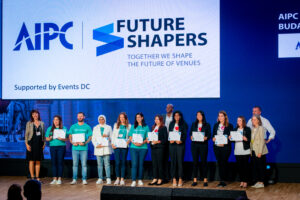
AIPC 2022 Congress Future Shapers Presentation and Awards
What positive impact does ICC Sydney have on the local economy?
In line with ICC Sydney’s mission to make a difference for clients, stakeholders and the community, the team fulfils dual purposes of equal importance – running events that provide positive economic impacts to our city and as an important piece of social infrastructure that drives benefits for our community. In this way, the events ICC Sydney delivers are the catalyst for far-reaching positive social and financial impacts – from sparking trade and investment, innovation, research, and development projects to enhancing connection to local heritage and culture, knowledge exchange and programs that support emerging talent and people in need within our communities. Events held at ICC Sydney provide economic benefits to the broader economy. In fact, only 10% of the spending associated with an event generally goes to the host venue. 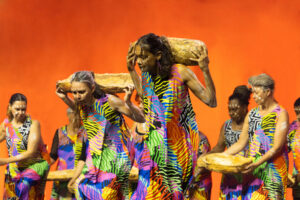
How does ICC Sydney measure its economic impact?
Every financial year, ICC Sydney reports on delegate spend in the local economy and in FY19, events hosted at the venue contributed AUS $900m (USD $617.39). Importantly, ICC Sydney is on track to return to deliver AUS $1b annually in economic contribution to the city and regional communities within the next two years. We have had the greatest success in community and stakeholder engagement through our Legacy Program, which takes concentration beyond our team and our management of the venue and into the events we host as well. Connecting event organisers and delegates with First Nations cultural experiences, expertise, and businesses to the talent of our entrepreneurs, students, and creatives while also seeking to reduce the environmental impacts of events. We seek to support our clients to also make decisions that will reduce their environmental footprint while deepening a positive social handprint through the delivery of business events.
Can you tell us about any recent innovations or developments at ICC Sydney that have improved the venue’s operations?
Sustainability is at the core of ICC Sydney’s business practices, alongside business operations and risk. Our Corporate Social Responsibility (CSR) program adopts a triple bottom line approach, considering the ways in which we can foster community engagement, environmental sustainability, and economic development. We have adopted the United Nations Sustainable Development Goals (SDGs), to ensure we are part of a united global conversation and in line with the ASM Global ACTS framework, ICC Sydney actively Invests in People, Protects the Environment and Strengthens our Communities. Regarding limiting environmental impacts, ICC Sydney can help reduce an event’s waste to landfill, energy emissions and water use by supporting event planners to understand the overall estimated carbon footprint of their event. Carbon footprint analysis takes into consideration the type of event, event duration and size, food and beverage arrangements, flooring and stands, estimated energy consumption, waste, and staging. The venue’s culinary experts have selected seasonal produce to create world class dishes that have been reviewed to estimate the carbon footprint associated with the farming, harvesting, production, and transportation of ingredients – resulting in 186 carbon friendly options across six core menus. ICC Sydney’s Edible Centrepieces initiative forms part of its Legacy Program, reducing waste while supporting members in the community that are most in need. Edible Centrepieces allow clients to replace or enhance floral arrangements with table centrepieces created from seasonal vegetables and herbs, sourced from the venue’s 129 New South Wales-based network of suppliers. These unique arrangements can be displayed in complimentary recycled vases. Post-event, the culinary team use the ingredients to cook and donate nutritious meals to the Matthew Talbot Hostel.  Located on Gadigal Country where Tumbalong (Darling Harbour) meets Gomora (Cockle Bay), our approach to reconciliation strengthens both our community and our diverse team and provides meaningful experiences with First Nations people and culture for hundreds of thousands of visitors every year simply by attending an event in our venue. ICC Sydney’s commitment to delivering on its Reconciliation Action Plan has helped it to strive for equality and social justice as the impact is threefold. ICC Sydney’s team is ever more diverse and inclusive, our clients can enrich their delegates’ experience by connecting them to the culture, knowledge and businesses of First Nations people and our advocacy for reconciliation helps us to deepen our understanding of and relationships with our First Nations community, to respectfully acknowledge culture and to create opportunities that make a difference.