Theo Reilly analyses travel connectivity in three cities: Boston, Houston and Las Vegas. The USA mostly runs on cars and jet engines. Its huge landmass and pride in private ownership have made planes and automobiles the currency of travel. But bustling airports and highways aren’t the only gauge of connectivity in US conferences. Some American cities have approached urban planning from an entirely different angle, and none more so than Boston, Massachusetts. Big Digs, boondoggles and business events Frederich Engels once said that “Boston is just a village … more human than New York City”. This localised, interconnected quality is what makes the New England capital a major player in business events. Boston is a small city – about a third of the size of Chicago and San Francisco. Downtown is a compact area, criss-crossed by bus links, footpaths and a subway system. The city’s iconic early-American architecture is packed into the centre, and you can see most of it in a 4km walking tour. But there’s more to connectivity than closeness. In the 50s, central Boston was a very different city – suffering from neglect and an exodus of professionals to the suburbs. Out of resignation came one of the worst decisions in Boston city planning history: the construction of a huge, elevated freeway that cut through the heart of the city. Not only was it a terrible eyesore, it actually made traffic worse. Writer and historian Bill Bryson said at the time: “[The freeway] wasn’t a road system, it was mobile hysteria.” The decision to demolish the ‘Central Artery’ and replace it with an underground highway has made Boston the city it is today. The project certainly wasn’t without its dramas – marred by corruption, soaring costs and a deadly tunnel collapse. Now, however, the city can see the positive side: the road system has completely revitalised South Boston. Before the Big Dig, the waterfront area of South Boston was cut off from the rest of the city. Now, a new extension feeds into the Seaport in South Boston and across the harbour direct to Logan International Airport.

Big Dig construction
The project caused a development boom. In 2014, the Seaport District of Boston was considered “the hottest, fastest-growing real estate market in the country”. Among the new developments in South Boston is the BCEC – the Boston Convention and Exhibition Centre. The largest of its kind in Massachusetts, the centre has over 500,000 sqft of exhibition space. We asked Martha Sheridan, CEO of Boston’s convention and visitors bureau
Meet Boston, what she thought of the Big Dig and Boston’s connectivity. She told us: “The Big Dig created a more efficient and effective wayfinding system for Boston, improving transportation and navigation. “All these factors matter when it comes to hosting events. The Greenway, for example, serves as a conduit between Chinatown, Downtown, Fort Point, the Financial District, the Waterfront, Faneuil Hall, the North End and West End.” Kristin Schoenstein, chief of staff at eTail, the e-commerce conference, shared her team’s reasoning for choosing Boston as their 2024 host city: “The event is always held at a hotel near the Prudential Centre, a great hub for shopping and restaurants. Amtrak’s Back Bay Station is within walking distance and also connects to Boston’s Logan Airport on the T. “Attendees always give
eTail Boston rave reviews, and whenever possible, we try to give them the opportunity to get outside the conference centre to see iconic sites like the Boston Seaport and Fenway Park.”
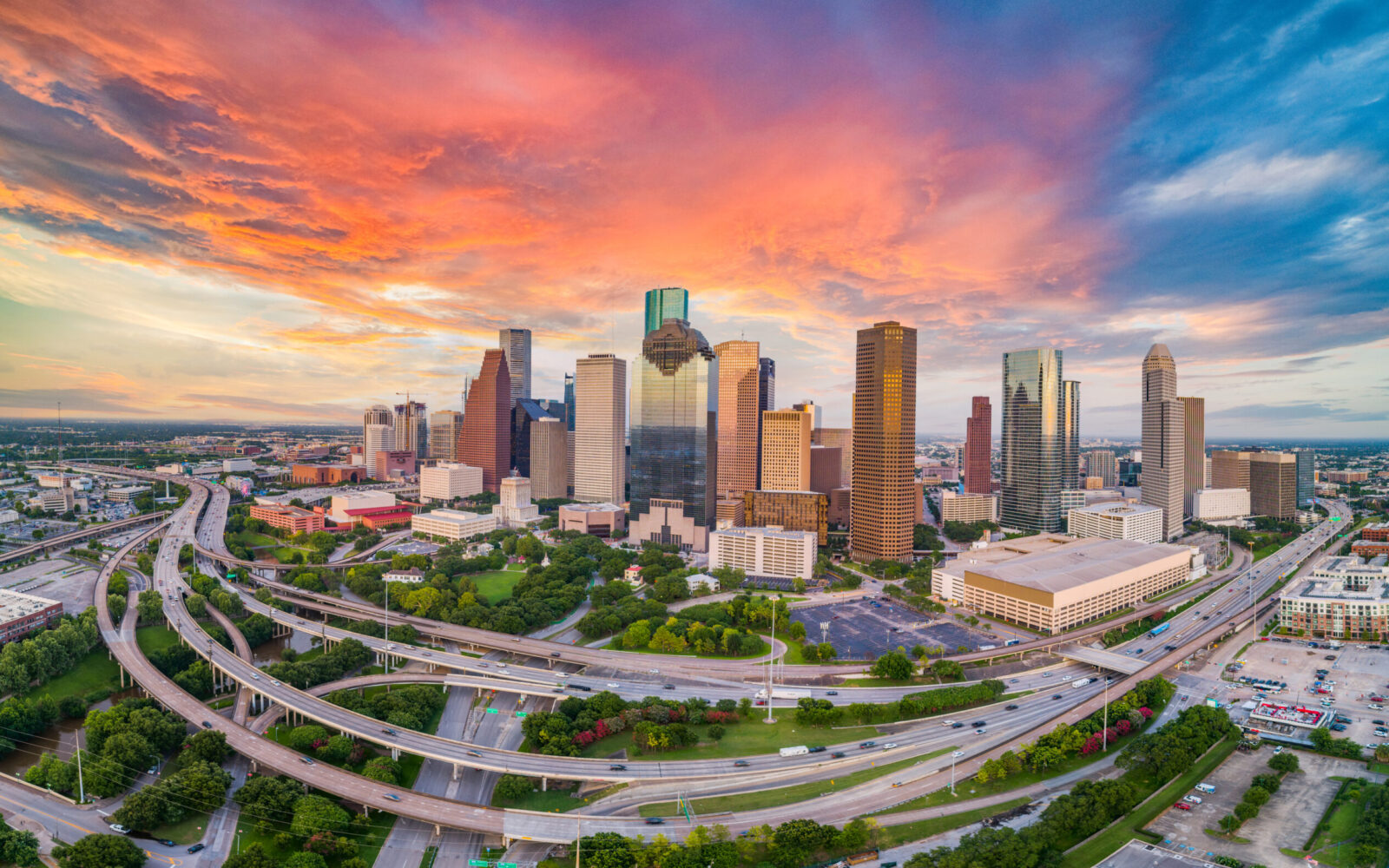
Highway to Houston Houston is Boston’s polar opposite. It’s one of America’s largest cities, known for gas guzzling cars and scorching summers. Walkability is not a Houstonian trait. Catering to a driver population, public transport has been shunned in favour of a sprawling highway system. The widest highway in the world is in Houston – the Katy Freeway, 26 lanes across. The city may not be designed with pedestrians in mind, but it has something else going for it. Houston is home to two airports: one small and convenient, the other huge and bustling. The first is William P. Hobby (HOU), 10 miles from the centre of town. The second, much larger airport is George Bush Intercontinental (IAH), United Airlines’ second largest hub in the USA. Both airports achieved impressive rankings in 2024’s ‘World Airport Awards’ by Skytrax, global air transport rating organisation. Bush Intercontinental came in at fourth in the US and 38th globally, while William P. Hobby ranked an impressive third in the US and 29th worldwide. Back in 2022, Hobby became the first North American airport to gain a 5-star rating by Skytrax. It joined a list of just 16 5-star airports in the world. Skytrax commented at the time: “[William P. Hobby] embarked on a major journey of quality change and improvement over the last four years, and… has made further significant upgrades to guest facilities in the past two years.” But for cheap flights and mass availability, the winner is George Bush Intercontinental. With more than 500 daily arrivals, it’s one of the busiest airports in the American South. Any large event in Houston will rely on Bush’s teeming network. The airport spans over 44sqkm. As well as being well-positioned as a meeting point for both coasts of the US, it’s also a major gateway to Central and South America, servicing 54 cities across Latin America, Mexico and the Caribbean. The downside of choosing George Bush Intercontinental is its location. Connecting to the airport is easy; connecting from there to downtown is more of a challenge. Delegates have to choose between a bus route, taxis and shuttles to make the 27km journey. Ubers will run around $35 and take up to an hour and a half to arrive. For a higher price tag, attendees can opt for the much closer, much smaller William P. Hobby Airport. 11km closer than Bush Intercontinental, Hobby airport is linked to downtown Houston by 20-minute transfer. Michael Heckman, president and CEO of
Houston First, explains why Houston’s connectivity is a major selling point: “Domestic clients know that their conference attendees will be able to get here easily from both coasts and just about anywhere else in the continental US within just a few hours. We’ve also been able to secure international conferences in areas such as energy and healthcare thanks in large part to our robust airlift led by United Airlines.”

Houston, we have a conference
The desert is a city planner’s dream. Nevada’s Las Vegas Strip was built from nothing in less than 80 years. Across a 4.8km span, dozens of hotel-casinos are packed in among convention centres, restaurants and entertainment – all a 15-minute drive from Harry Reid International. This proximity doesn’t translate to walkability, unfortunately. The Strip is a driver’s town, so much so that taxi lobbyists managed to shut down plans to build a light rail servicing the Strip from the airport. Upon arrival at Harry Reid LAS, it’s a choice of automobiles – taxi, Uber/Lyft, bus or shuttle. It takes about 10 minutes for a $23 taxi or Uber/Lyft ride-share, an hour for a $4 bus ticket, or half an hour for a $30 shuttle. Even while at the Strip, delegates are still calling cabs. Las Vegas is one of the hottest cities in America, and hotel plots are deceptively large – it takes almost 10 minutes to walk from one end of Caesars Palace to the other. Gabriele Tagliavia is COO of
talixo, an international company that provides ground transfer services. On the question of pre-booked vs spontaneous ground transit in Las Vegas, she says: “Where pre-booked rides really come into their own in Vegas in terms of cost and reliability, is when a number of events overlap. While taxis have fixed fares, queuing at taxi ranks can be ridiculous – especially when a lot of visitors are trying to get around at the same time, like at the end of a conference day.”

The Las Vegas Loop
There is also a monorail servicing various casino-hotels on the Strip. Built by the same firm that made the Disneyland monorails, it’s the only privately-owned transit system in the USA. Ridership is quite low, as many Vegas hotels don’t have their own stops, and it can take up to 10 minutes to walk from the station to the hotel entrance. Expanding travel links even further, in 2021 the Las Vegas Convention and Visitors Authority (LVCVA) opened the Loop – an underground tunnel servicing five stations in the Las Vegas Convention Centre. The LVCC is Vegas’ largest convention centre, followed by the Venetian Expo and the Mandalay Bay Convention Centre. Elon Musk’s ‘The Boring Company’ built the LVCC’s tunnels, and uses Tesla Model 3 cars to ferry passengers along them. Rebecca DeLuca, vice-president of destination sales at the
LVCVA, said: “Las Vegas is easily accessible from every corner of the world, offering over 1,100 flights daily with direct routes from 148 cities. [We have] 151,000 hotel rooms and 15m sqft of convention space all within a relatively condensed footprint.” Las Vegas continues to win a huge share of conference business in the USA. In terms of connectivity, the city is between Boston and Houston – a driver’s town that also benefits from tightly-packed facilities and a well-located airport. It may not have the walkability of a petite village-city like Boston, but it would hardly be the Vegas we know if it did.