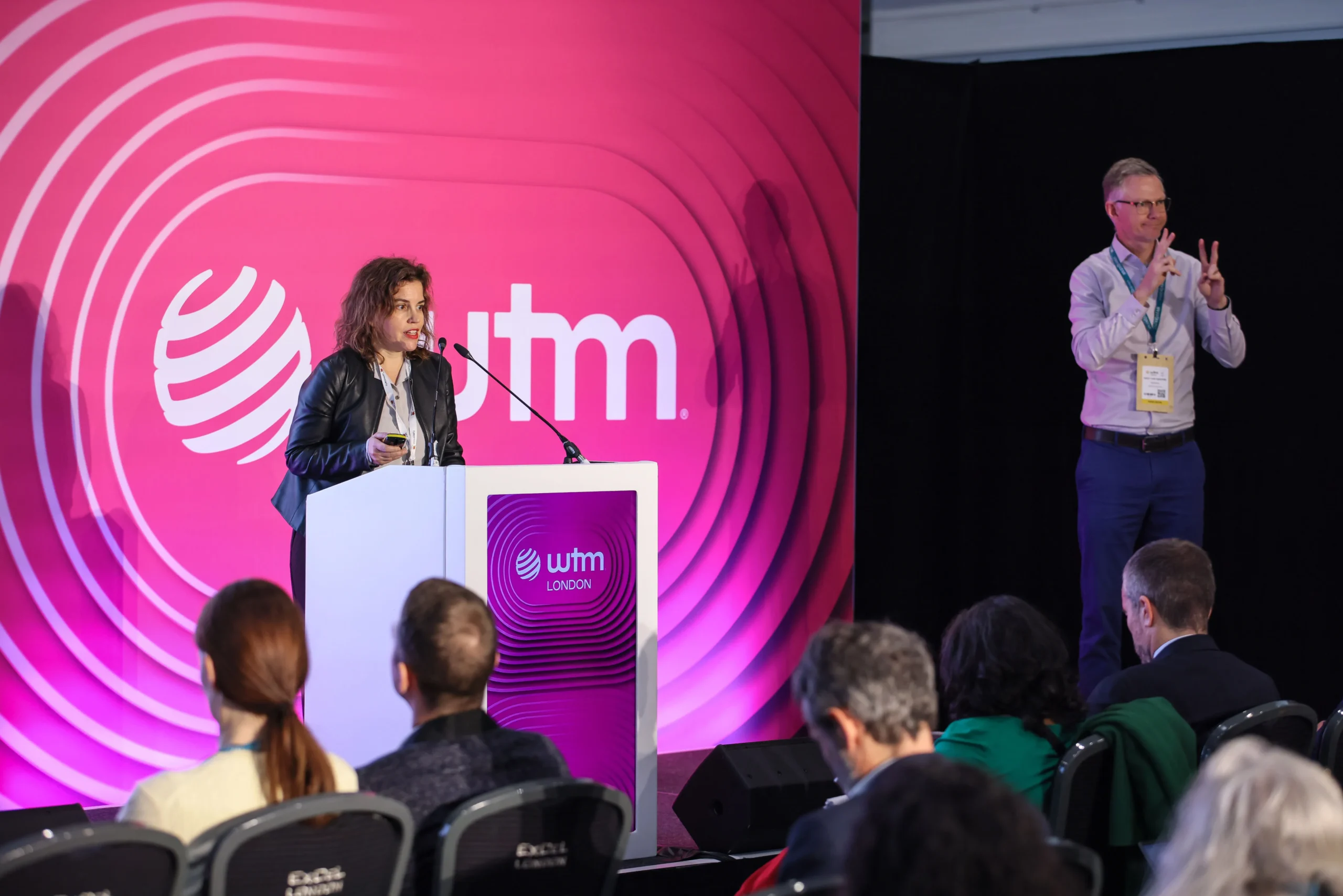
WTM London 2026 opened with some of the travel industry’s biggest debates taking centre stage, led by the launch of WTM’s Global Travel Report, in association with Tourism Economics, alongside a newly structured conference programme.
The Global Travel Report’s findings was live streamed from the International Media Centre to all four of the event’s main stages.
Dave Goodger, managing director for Tourism Economics noted that the erosion of consumer spending power was an ongoing issue, but the bigger picture is that “travellers are reallocating resources and looking to save where they can.”
Experience is such an important part of tourism it now has a dedicated hub at WTM London. In The Experience Economy: Niche is the new mainstream, Angela Val, from Visit Philadelphia, emphasised the economic opportunity in building immersive tie-in activities and itineraries around key events, focusing on Taylor Swift. “That has really changed the way we look at concerts in Philadelphia,” she said. “It has become normal [for people to] go to a concert and want to experience something outside of it… to embrace it for the three days [they’re] there.”
Philadelphia seized a similar opportunity by mounting a range of free fringe events during this year’s FIFA World Cup. In fact, its Fanfest was the most attended of the tournament, pointing out that “70% of people who go to the World Cup don’t have a ticket”.
A panel on the Trends stage debated “passion tourism” – music, sports and cultural events. Luiza Fortuna from Superstruct Entertainment shared some data about Awakenings, an annual techno festival in the Netherlands it owns and organises. “The audience is pretty much a 50-50 split of Dutch and international visitors. But of these international guys, 80% of them say that they wouldn’t go to the Netherlands if it was not for the festival”.
The Global Trends Report found that 58% of international travellers have undertaken a trip abroad specifically to attend an event in the past two years.
Spain’s representatives identified accessible tourism as a way to not only increase its market share but also improve the experience for visitors with accessibility issues.
The Spanish Tourist Office launched a hotel advice guide and a series of social media ads created as part of its Spain for All accessibility strategy.
“We’re publishing a report which gives hotels in Spain and around the world the tools they need to communicate how accessible they are,” Spanish Tourist Office UK director, José Manuel de Juan González announced.
Miguel Carrasco, director of Tourism/COO for a series of accessibility organisations commented: “Accessible tourism is not a different kind of tourism, it is what better tourism looks like.”
On the tech-dedicated Future Stage, keynote speaker Ani Attamian reinforced that having “correct, connected and clear data” is essential for companies looking to use AI in both internal operations and external customer experiences.
She said there has been a 3,500% year-on-year increase in gen-AI traffic to US travel sites (July 2025), confirming its rapid adoption by mainstream travellers.
Also on the Future Stage, Natalia Talkowska from Natalka talked about “the neuroscience of desire” and how human emotions should be allowed to co-exist in the age of AI.
“The brain cares about stories that evoke emotion” she told her audience. “Stand out by creating desire,” she said, urging delegates to offer events such as dinners and spaces where groups of clients can connect and ‘de-tech’.
“Gathering audiences is the new luxury”, she stated, suggesting the travel industry “needs to build a world that connects people.”
WTM event director Chris Carter-Chapman said there was a “fantastic buzz” about the show, saying he was proud the travel industry had shown “strong resilience”.
He reported more than 12,000 approved buyers were registered this year and 4,000 media figures, he said, that “really communicates the importance of the show within the UK economy.”