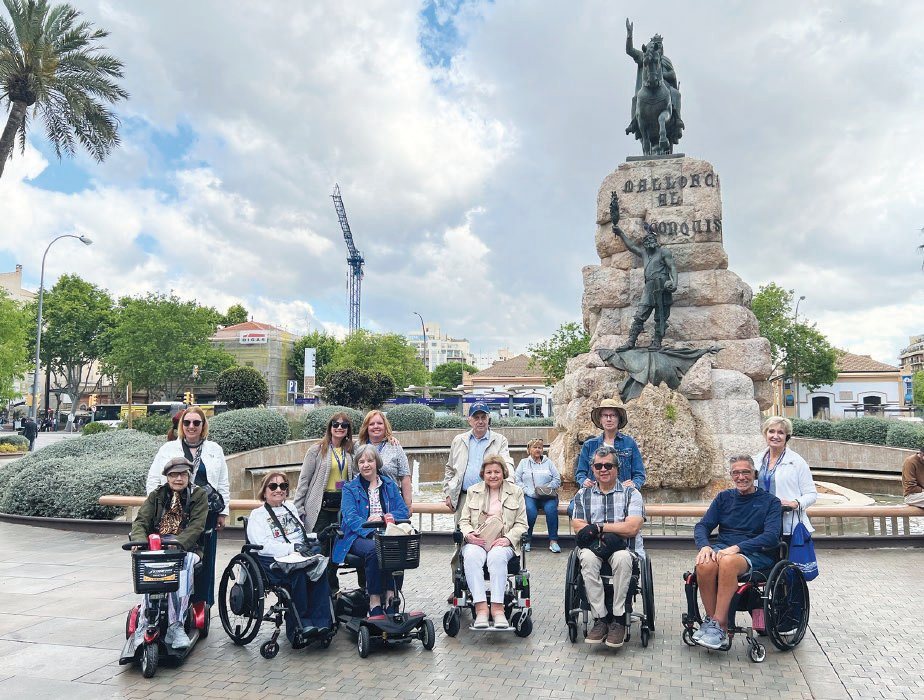
In the high-stakes world of business travel and meetings, accessibility is no longer a niche concern or a compliance checkbox. For John Sage, it is a lived reality and a professional mission. As a manual wheelchair user who has travelled to more than 50 countries, John Sage brings more than 15 years of practical expertise to helping destinations, venues and event organisers remove barriers and improve the guest experience.
Multiple trips as a wheelchair user revealed a consistent pattern to him: planning accessible journeys was time-consuming, information was incomplete, and “accessibility surprises” were common.
In 2009 he founded Sage Traveling, focused on delivering accessible European holidays and, in 2016, he launched Accessible Travel Solutions, a B2B operation supplying accessible travel packages to agents and shore excursions to cruise lines. A further evolution came with Sage Inclusion, which today delivers training, assessments, certification and marketing support.
John Sage now advises the World Travel & Tourism Council (WTTC), UN Tourism, the Global Business Travel Association (GBTA), the Professional Convention Management Association (PCMA) and IMEX, among others, and was primary author of the WTTC Inclusive and Accessible Travel Guidelines. People with disabilities represent more than 15% of the population, yet remain systematically underserved.
He frames the solution around three pillars: facilities, customer service and accessibility information.
He admits venues around the world have improved their facilities in terms of accessibility in recent years, but says progress is very uneven.
“In the United States, the ADA created an important baseline for physical accessibility, and internationally we are seeing more venues investing in accessible entrances, restrooms, seating, wayfinding, hearing accessibility and other physical improvements. But one of the biggest lessons from our work is that legal compliance does not necessarily create an accessible attendee experience.
“A venue can technically meet building requirements and still create significant barriers because staff have not been trained, accessibility information is difficult to find, or attendees do not know what to expect before they arrive.”
That conversation is changing, with both venues and event organisers now looking at accessibility not only as a compliance requirement, but as part of customer experience, reputation and competitiveness.
John Sage’s team has certified many major events, including PCMA’s Convening Leaders, and he outlines progressive levels of inclusion, moving beyond exclusion (a wheelchair user cannot enter) or segregation (separate transport or routes) towards genuine integration.
The Sage Certification programme evaluates venues and organisations across five disability categories – mobility, vision, hearing, neurodivergence and allergy. The Pennsylvania Convention Center became the first to achieve certification across all five.
When accessibility is designed in from the start, he argues, businesses gain competitive advantage, destinations become more attractive, and travellers with disabilities, and their companions, can participate fully.
The perceived cost of an accessibility audit can be a problem, but John Sage believes that a larger barrier is the assumption that improving accessibility automatically requires a large budget. Many meaningful improvements are operational and relatively inexpensive, he notes.
“We regularly identify things that can be improved through better information, staff training, changes to procedures, or small adjustments to the physical environment. That is why our assessment process prioritises improvements based on both impact and cost rather than simply giving a venue a long list of deficiencies.”
Another challenge is ownership, he says. “Accessibility often touches operations, facilities, marketing, technology, registration, food and beverage, security and planning. When no one owns the entire attendee journey, gaps appear between departments.”
True accessibility, John Sage stresses, means looking at the person’s entire journey rather than focusing on one disability type or one physical feature.