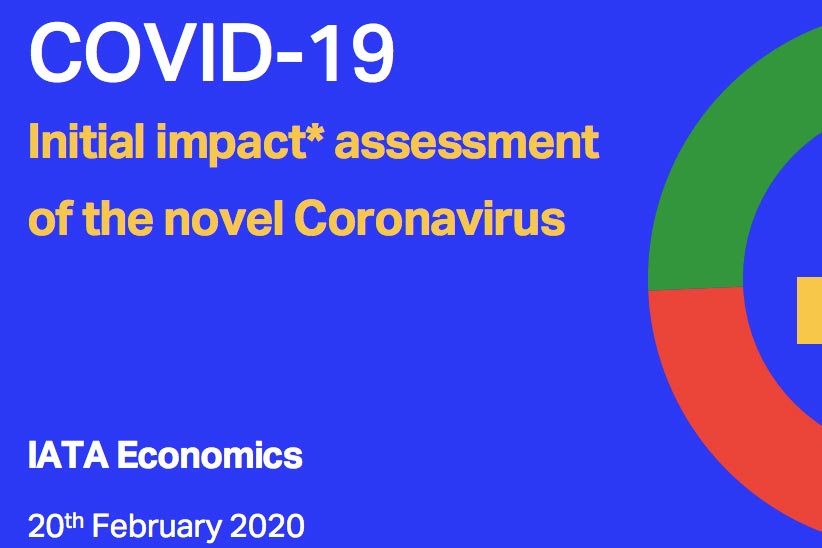
Airlines in Asia Pacific stand to clock up a 13% drop in passenger demand due to the coronavirus, according to the International Air Transport Association (IATA). The association said that could translate into a $27.8bn revenue loss this year in Asia Pacific, while those airlines outside Asia are expected to lose $1.5bn. The association said it had based its predictions on the V-shaped impact ondemand recorded during the SARS outbreak in 2003. That model saw six-month sharp drop in demand followed by a quick recovery. IATA estimated SARS had led to a 5.1% fall in demand for airlines in the Asia-Pacific. The estimated impact of the COVID-19 outbreak also assumes that the centre of the public health emergency remains in China. If it spreads more widely to Asia-Pacific markets then impacts on airlines from other regions would be larger. “Airlines are making difficult decisions to cut capacity and in some cases routes,” IATA’s director-general Alexandre de Juniac said. “This will be a very tough year.” Australia’s Qantas airline said on 20 February that the outbreak would cost it up to AUD$150m Australian (US$99m) and Air-France KLM are projecting the cost at up to $213m for the period between February and April 2020. Private jet carriers have reported higher demand, although are hampered by lack of availability of crew and travel bans enforced by governments. The World Health Organisation, it must be reminded, has not called for restrictions on travel or trade. Indeed, air transport plays a major role in bringing medical staff and supplies to where they are needed. See the WHO website for latest advice. Passengers should be reassured that cabin air is filtered, that aircraft are cleaned in line with global standards, that key airports have implemented temperature screening for travellers and that airline staff and crew are trained to deal with the rare case of a passenger presenting with symptoms of infection. “If you are sick, don’t travel. If you have flu-like symptoms, wear a mask and see a doctor. And when you travel wash your hands frequently and don’t touch your face. Observing these simple measures should keep flying safe for all,” said Dr David Powell, IATA’s Medical Advisor. Read IATA’s Initial impact assessment of the novel coronavirus report herehttps://www.iata.org/en/iata-repository/publications/economic-reports/coronavirus-initial-impact-assessment/
Coronavirus set to cut Asia Pacific air passenger numbers by 13%, says IATA study
Airlines in Asia Pacific stand to clock up a 13% drop in passenger demand due to the coronavirus, according to the International Air Transport Association (IATA).
Comments
Comments are closed on this post.
Trending
Beyond attendance: How conferences can grow membership, strengthen communities and create lasting impact
1 week ago
Australian airfares remain below inflation despite soaring costs, according to Flight Centre index
1 week ago
IMEX America achieves top neurodivergent inclusive event design endorsement
3 days ago
Nearly 9 in 10 destinations improve as Helsinki leads 2026 GDS-Index
1 week ago
PCMA members approve 2027 Board of Directors and Trustees slate
1 week ago
Cairns doctor launches skin cancer conference, with a day on the Great Barrier Reef
2 days ago
Beurs van Berlage becomes a B Corp and achieves Green Globe Gold status
1 week ago
Advertisement
Essential Reads
New EIC study finds business events contribute US$1.8 trillion to global GDP
Analysis

Washington DC bucks trend of US tourism decline with record visitor spending
North America

A look back at November’s IBTM and how event formats are “festivalising”
IBTMWorld

US airports face potential closures amid government shutdown
Business Travel
The countries with the highest business travel spend in the world
Business Travel
More like this