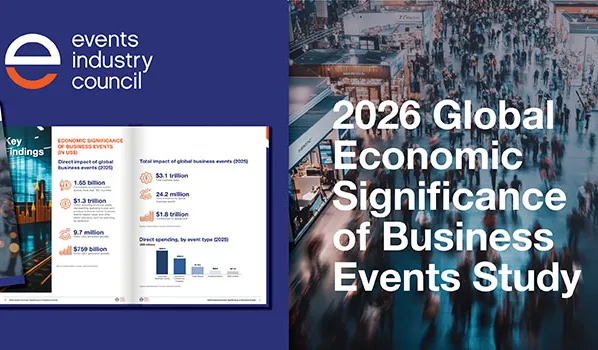
The Events Industry Council (EIC) has released new regional reports from its Global Economic Significance of Business Events Study, providing data to help industry leaders and policymakers understand the economic contributions of business events around the world.
Conducted by Oxford Economics, the study reveals that business events generated $1.3 trillion in direct spending globally in 2025, supporting $3.1 trillion in total economic activity, $1.8 trillion in GDP and 24.2m jobs.
EIC also announced Marina Bay Sands as a new Premier Partner of the 2026 Global Economic Significance of Business Events Study.
The collaboration supports efforts to highlight the critical role business events play in the global economy.
“Business events are essential to connecting industries, advancing innovation and driving economic growth,” said Ong Wee Min, vice-president of sales and MICE, Marina Bay Sands, who became one of the first Asian business event professionals to be inducted into the EIC Hall of Leaders in 2026. “We are proud to support research that quantifies this impact and helps destinations, businesses and policymakers recognise the long-term value of investing in our industry.”
Alongside its support of the study, EIC and Marina Bay Sands have renewed their three-year strategic partnership. The renewal builds on a relationship established in 2023, when Marina Bay Sands became EIC’s first strategic partner in Asia. It will extend both organisations’ efforts to advance sustainability education and professional development across the global business events industry.
The EIC regional reports offer a more detailed picture of the industry’s economic footprint and its contribution across different markets:
- North America: With $487.7bn in direct spending, North America represents the largest regional business events market, accounting for nearly 38% of global direct spending.
- Asia: Generating $352.8bn in direct spending, Asia is the second-largest regional market and leads the world in business events participation, welcoming more than 608m participants in 2025.
- Western Europe: Business events generated $328bn in direct spending, contributing to $766bn in total economic activity and supporting 4.8m jobs.
- Latin America and the Caribbean: The region generated $42.6bn in direct spending and welcomed approximately 85.7m participants, highlighting the economic significance of business events across its markets.
- Central and Eastern Europe: Business events contributed $34.1bn in direct spending, with approximately 68.6m participants, demonstrating the industry’s reach across the region.
- Africa: The continent generated $25.8bn in direct spending and welcoming approximately 65.8m participants.
- Middle East: Business events generated $21.1bn in direct spending and attracted approximately 33.7m participants.
The new reports translate global findings into regional evidence, highlighting differences in economic scale, participation and employment contributions.
“These regional findings provide powerful evidence of the role business events play in creating economic opportunity and supporting long-term growth and legacy impact,” said Amy Calvert, president and CEO of the Events Industry Council. “They give our global community a strong foundation for a unified message, helping demonstrate why investment in business events, infrastructure and workforce development matters to economies and communities everywhere.”
Adam Sacks, president of Tourism Economics, an Oxford Economics company, said: “These reports equip stakeholders with comparable data to demonstrate the industry’s economic contribution and make a more informed case for investment.”
With global direct spending forecast to reach $1.57 trillion by 2028, the findings point to continued opportunities for economic growth and industry development.
Explore the Regional Reports.