Cassie Barnes, client director, Smyle at WEF in Davos, shares some tips and strategies for success on one of the world’s biggest and most influential meeting stages: The World Economic Forum (WEF) provides one of the most important dates in the calendar for over 2,500 political, business and academic leaders who descend on the small town in the Swiss Alps every year. WEF has grown significantly in the last decade, establishing itself as an important meeting platform for global influence.
While official attendance is by invitation only, thousands more gather to participate in satellite events, partnerships, and brand experiences that orbit the main forum, creating an expansive ecosystem of influence and opportunity. The result is the single most concentrated gathering of global decision-makers.
CMW asked international agency Smyle’s client director Cassie Barnes about working on the WEF and how the contract come about. “We’re currently planning for our 10th year at the World Economic Forum in 2026, with six client activations lined up so we’re growing all the time,” she says”
Our first foray came back in 2016 when one of our tech clients had asked us to activate for them in Bedford Square in London. It was a successful event – so much so that they had a vision to move it to WEF and recreate it in about four weeks. Smyle’s journey to Davos was born from that moment. It was a real demonstration of short turnaround, agile, adaptive thinking from the team to make it happen and taught us a lot about the nuances of working in this environment.”
From that point forward Barnes says Smyle started to work in Davos annually where the agency honed its “vital on the ground connections and partnerships that are just as much part of the key to success”. Eventually the agency began to work with other clients in the financial and tech sectors to bring their visions to life, and quite often, says Barnes, it involves working up their path to Davos.
“We work with our clients to understand their ambitions and develop a multi-year, multi-step roadmap to get them where they need to be. Often it’s about progressive development rather than expecting to arrive fully formed.”
With briefs from a variety of clients working in dfferent sectors, different client approaches are clearly required. “Firstly,” says Barnes, “it’s important to note that there is no one way to show up in Davos.
“Smyle worked on four different approaches this year: temporary hire for newcomers testing the waters, hotel residencies claiming space without full build complexity, complete venue takeovers transforming existing spaces, and fully bespoke custom builds creating premium executive environments from scratch.
“The key is being clear about your goals and curating an approach that strategically aligns. Our focus is always on commercial ambitions and scalability aligned to clients’ objectives. Branded presence has to be relevant to the topics and themes of WEF – you can’t just show up without connecting to the broader conversation.
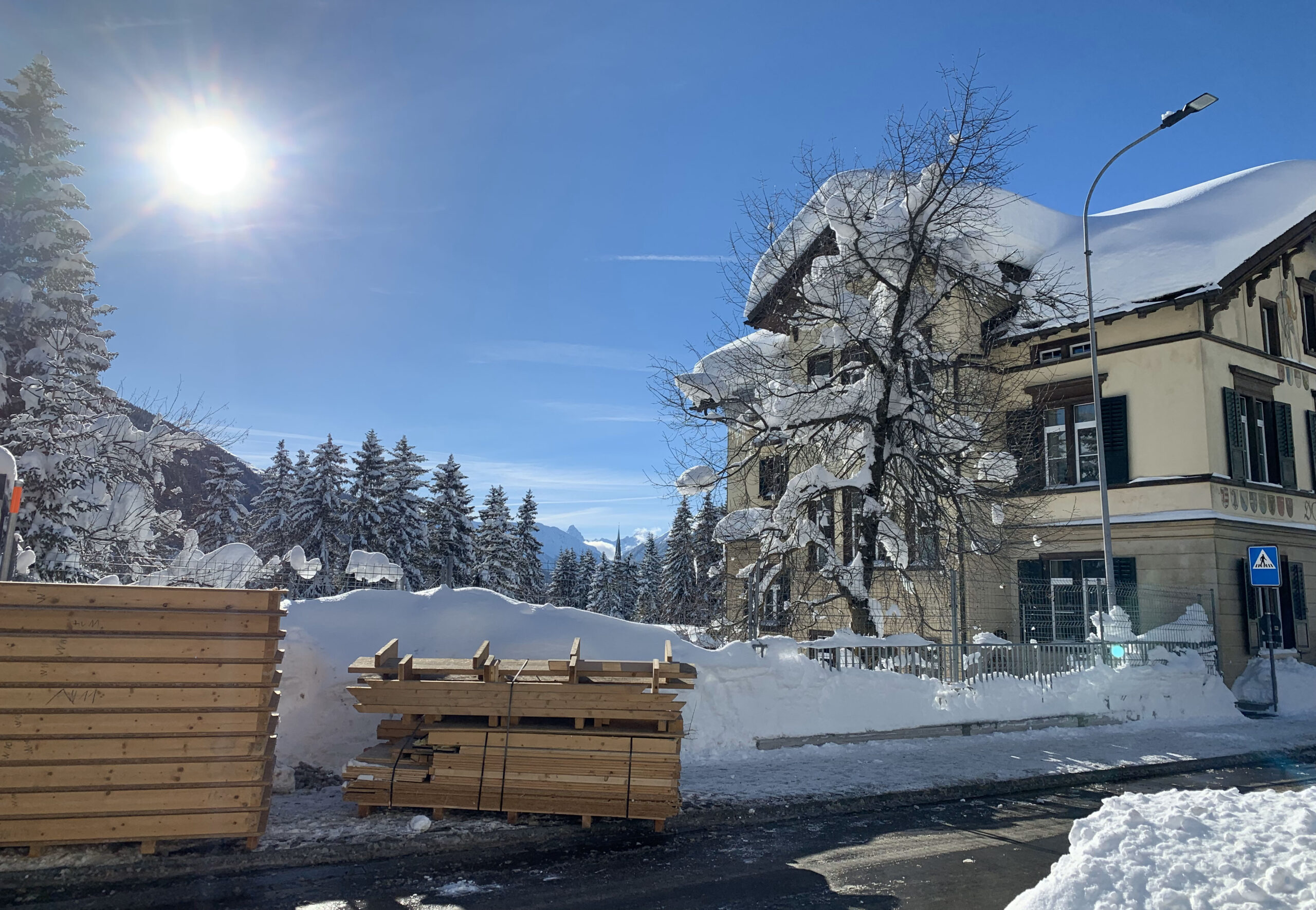
Cassie Barnes, client director, Smyle“What’s fascinating is how different each planning phase becomes depending on the approach. A custom build starts 12 months out with site surveys, permits, and structural engineering – you’re essentially creating a pop-up venue that needs to withstand Alpine conditions while feeling world-class. The logistics alone are mind-boggling when you’re trucking materials up a mountain in January.”
Barnes goes on to note that shopfront takeovers have their own complexity. “You’re working within existing architectural constraints but the timeline is much tighter – sometimes we’re designing and fitting out in just a few weeks. It’s about maximising impact within fixed parameters, which honestly can be more creatively challenging than starting from scratch.”
Residencies, she explains, are perhaps the most nuanced of all because you’re integrating into someone else’s space and operational flow. “The planning becomes as much about relationship management and operational choreography as it does about design,” says Barnes. “Each approach demands completely different skill sets from our team.”
Biggest challenge?
So what does Barnes think are the biggest challenge at Davos? “Let’s start with the obvious – we’re literally up a mountain in minus degree temperatures! But beyond that, understanding the level of audience is key to brands engaging in the right way. Every moment matters when you’re trying to capture people for small increments of time while they’re walking down the Promenade between important meetings.
“It’s also about longevity strategy – brands need to show up for the right reasons and think long-term rather than just making a splash for one year. Successful brand presence is always part of a broader strategic commitment to the conversations and issues that WEF represents.”
The audience is incredibly diverse, too, Barnes notes, highlighting the need to cater to multiple audiences and sectors: “You might have a tech CEO, a government minister, and an NGO leader all in the same space. The messaging and experience has to work across all those different perspectives and priorities.
Then you layer on the operational realities – it’s the side of a mountain, extreme temperatures, difficult build timelines, constantly evolving legislation, plus the added security considerations that come with a premium audience of world leaders. Your team is working in sub-zero temperatures, often around the clock, while maintaining the level of finish expected by this audience.
“Davos is a dynamic, ever-changing space and we have to be prepared to pivot at all times. The competitive landscape intensifies each year, real estate is at a premium, so helping brands stand out becomes increasingly challenging. Success comes in working in lockstep with your clients and teams to make the impossible possible.”
Each client brings different objectives as well, which reflects the diverse ways companies can leverage Davos. “From policy-focused conversations requiring intimate discussion spaces, to future-facing innovation storytelling that needed to make abstract concepts tangible,” says Barnes who notes that Davos rewards bold thinking.
Smyle at DavosShe adds that some clients were establishing their presence in this arena for the first time and needed to make an immediate impact, while others were returning with established reputations but wanted to signal evolution in their thinking or approach. “For example, we were tasked with uplifting and scaling one client’s presence at WEF for 2025. We sourced and completely transformed a hair salon in close proximity to their private hotel lounge into a public-facing exhibition and demo centre. The result was over 1,000 visitors to the public exhibition and a huge increase in executive meetings in the private space.”
The physical space requirements differs dramatically based on goals. Some need environments that balance approachability with gravitas for sensitive discussions, while Barnes says others require spaces that could demonstrate complex technology in practical, business-relevant terms.
“Each team operated differently too,” she says. “Some clients came with very clear visions and tight parameters, others wanted us to guide the creative process entirely. The common thread was that they all understood Davos isn’t just another event – it’s a stage where every detail gets scrutinised, and success comes from genuine purpose rather than pure showmanship.”
“Measurement is crucial too,” Barnes emphasises. “We focus on legacy learning and creating blueprints that inform their long-term strategy, not just the immediate activation.”
Takeaways?
And what are the key takeaways from working on such a high-powered global event and what are the ‘need-to-knows’ to save time, money and energy? “I’m personally heading into my 15th year with planning for 2026, and that long-term perspective has taught me that successful Davos activations require planning over multiple years,” says Barnes.
“Helping clients understand that this level of planning is going to drive efficiency and effectiveness – it’s not just about the immediate event, it’s about building toward something bigger. Understanding the ecosystem and building the infrastructure needed for success becomes a real competitive advantage when you’re working in such a unique environment.
For example, we were able to secure prime real estate along the Promenade for a client looking to increase their presence. Through our on-the-ground connections and understanding of changing legislation in 2025, we secured a spot that they wouldn’t have been able to access otherwise. It’s exactly the kind of advantage that comes from working in Davos year after year.
“The changes I’ve seen in that time have been remarkable. Sustainability has become non-negotiable – what used to be a nice-to-have is now a fundamental requirement. Clients expect zero-waste solutions and want to understand the carbon footprint of every decision. This shift actually creates better work though, constraints often spark more creative solutions.”
Diversity and inclusion have also become key components of the Smyle planning approach, with fully accessible buildings for all. “Every touch point is considered to provide value to all participants – from the width of corridors and screen heights, to access points for wheelchair users and braille panels. We measure projects against sustainability goals and generate post-event reports that inform all our future builds. It’s a great example of how constraints actually drive better solutions,” says Barnes.
She adds that the most successful activations provide inspiring environments that encourage meaningful dialogue. The biggest need-to-know, she believes, is that