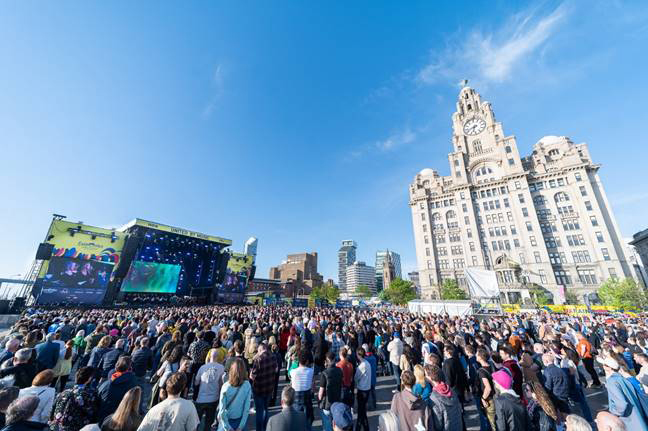
Research collated by Liverpool City Council has found that hosting the Eurovision Song Contest 2023 delivered a £54m (US$65.4m) economic boost to the Liverpool City Region. A council Steering Group commissioned five independent evaluations, and leader of Liverpool City Council, councillor Liam Robinson and Liverpool City Region mayor, Steve Rotheram announced the results, including nearly half a million people attending the event and 175,000 hotel rooms sold in May, the best month on record since 2018. The reports looked at the economic and social impact of staging the event on behalf of Ukraine, as well as the influence on cultural relations; the impact on wellbeing in the city and the wider city region; the visitor experience and the effectiveness of the strategic collaboration between delivery agencies. Key data highlights:
- Eurovision boosted the Liverpool City Region economy by £54.8m (net) with restaurants, accommodation providers, shops, bars and transport networks all benefitting.
- 473,000 people attended Eurovision events in the city, with 306,000 additional visitors heading to Liverpool to be part of the celebrations.
- In May, 175,000 city centre hotel rooms were sold – the best month on record since 2018. (STEAM data)
- EuroFestival – the Culture Liverpool curated two-week culture festival – presented 24 brand new commissions, 19 of which were in collaboration with Ukrainian artists. 328,346 people engaged with this programme including 557 artists, 1,750 participants involved in a commission and an audience of 326,039.
- The official Eurovision Village, located at the Pier Head, attracted 250,000 visitors across the ten days it was open, with the ticketed final selling out within hours.
An overwhelming 96% of visitors surveyed would recommend Liverpool as a destination to visit and 42% of overseas visitors said the city’s staging of the event had a positive impact on how they viewed the UK. The official Eurovision Fan Club – the OGAEs – carried out a survey and found that 99% of their members felt welcomed in the city. Eighty per cent of Liverpool residents noted how important it was for the city and a further 93% said they were pleased with how the city delivered the event. A further 475 people provided 12,000 hours of volunteering during the event and a Eurovision job recruitment fair saw 394 jobs offered in one day. A partnership between the BBC and Liverpool Institute for Performing Arts saw 145 students become part of the Eurovision production – in roles such as on stage dancers in the live shows, costume makers or in the TV production team. Between the period of October 2022, when Liverpool was announced as host city, until end of May 2023, more than 280,000 pieces of global news coverage were generated. The three live BBC shows were watched by 162 million people. More than 50,000 tonnes of waste was collected throughout the Eurovision period, 80% of which could be recycled. To bring together the findings of all the reports, Liverpool City Council’s Public Health team commissioned The Heseltine Institute for Public Policy, Practice and Place to compile the headline findings. This comprehensive overview can be found at the Heseltine Institute website. “There was never a doubt in my mind as to whether our region was up to the challenge of hosting a global spectacle like Eurovision on behalf of our friends in Ukraine – because nowhere does culture bigger or better than the Liverpool City Region. “The contest was also a vital shot in the arm for our local economy, bringing in more than £54m, creating thousands of jobs and opportunities for local people and showcasing our brand to an international audience.” Liverpool’s director of culture, Claire McColgan CBE, said: “We experienced this Eurovision-high as a result of cultural back catalogue. “We have spent years working towards what we all experienced in May – we cut our teeth during our European Capital of Culture year and from that point we have grown exponentially in confidence and ability as year-on-year we continue to deliver events that rival any other on the world stage.” Eurovision minister Stuart Andrew said: “It is fantastic to see the impact that hosting the Eurovision Song Contest has had on Liverpool. The city put on a fantastic display of culture and creativity, showing solidarity with our friends in Ukraine and highlighting what unites us all. “This research demonstrates the positive impact of hosting major events and I hope that we can continue to build on this success.” Photo: Crowds at the official Eurovision Village ©Liverpool City Council