Catie Owen sees first-hand the sustainable transformation of Singapore’s MICE industry Singapore’s MICE industry finds itself in a unique position. As a completely urbanised country, the island state’s MICE industry is incorporated into its daily existence. Singapore has six dedicated MICE venues, is brimming with hotels, and offers travellers a wide portfolio of incentives to indulge in. As a location with a strong reputation for sustainability, its unsurprising that Singapore is keen to make its MICE green. This move was reaffirmed with the launch of its MICE Sustainability Roadmap at IBTM World in November-December. Crucially, Singapore is walking the walk regarding its sustainable commitments – which is abundantly clear to anyone who sees the city first-hand. Visiting Greentech Taking place, 17–18 November 2022, the Greentech Festival had its Singapore debut as it highlighted companies behind current green technology. The Festival was founded by former Formula 1 World Champion Nico Rosberg and two engineers: Marco Voigt and Sven Krüger. The event usually takes place in Berlin, but Singapore’s sustainability drive made it an ideal secondary locale.
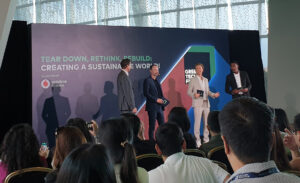
Nico Rosberg (middle right) at the Greentech Festival
- A city in nature
- Energy reset
- Sustainable living
- Green economy
- Resilient future
When asked about the motivation behind the city’s sustainable movements, it was clear that many Singaporeans feel the drive to do what they can for the planet. But there are also pragmatic considerations. To function, Singapore has a few unique challenges that the country’s newness has allowed it to tackle head-on with modern technology. For example, building a diversified and sustainable water supply has been a necessity due to the city’s pressing lack of it. Additionally, Singapore’s limited land mass means that, when they run out of usable space, land from the surrounding ocean needs to be reclaimed. These challenges put sustainability at the top of the country’s agenda early on. Green tourism The STB has stated that tourism accounts for 4% of Singapore’s GDP, meaning that the events and hospitality industries are crucial to the city’s sustainable development. Following in the footsteps of the Green Plan, the newly launched MICE Sustainability Roadmap has outlined its industry’s path to net zero by 2050. The roadmap moves quickly. It pushes its six MICE venues and 80% of its MICE association’s (SACEOS) members to become nationally or internationally sustainable-certified by 2025. Its MICE industry will start tracking waste and carbon emissions by 2023. Proving the green thumb When investigating Singapore’s sustainable commitments, it’s easy to get lost in the numbers without seeing the proof in the pudding, so to speak. Here we circle back to the city’s verdant urban landscape, where it’s clear to every visitor that time and care have been put into curating the vibrant greenery. It’s an ongoing initiative, started in 1967 by Singapore’s first prime minister, Lee Kuan Yew. Today, its hospitality industry has rallied to the cause – with the PARKROYAL hotels standing out. The PARKROYAL COLLECTION Marina Bay boasts a ‘garden in a hotel’ as its main hub is brimming with both flora and fauna – clusters of housed birds serenade the suited business travellers. The emphasis on incorporated greenery seems standard across the hotel chain, as its Pickering location grants guests an unobstructed view of its expansive plant-filled balconies. To complement its array of solar panels Marina Bay has another eco-friendly surprise up its sleeve: an on-site edible garden completely accessible to guests. The hotel chain is so deeply invested in its sustainable urban farm, which provides its kitchen ingredients, that the Pickering location has plans to establish its own. Exploring Singapore

The Cloud Forest at Gardens by the Bay