Thailand has put a number on its sustainability ambition and built the tools to let organisers check the working. TCEB‘s Supawan Teerarat calls it a shift from aspiration to achievement.
Ask an association board what has changed most about destination selection over the past five years, and capacity rarely comes up first.
What comes up is proof. Boards, funders and corporate sponsors increasingly want to see what an event actually did. How much carbon it produced. How much delegate spend stayed in the host community. What was left behind once the stands came down. Destinations that can answer those questions in numbers are being shortlisted. Destinations that answer in adjectives are not.
Thailand has spent recent years building an answer of the first kind.
A target with a number attached
In January 2026, the Thailand Convention and Exhibition Bureau (TCEB) set out a sustainability mission with a specific figure at its centre: a reduction of 20,000 tonnes of CO₂e by 2030, as a staging post towards carbon neutrality and a net zero carbon future for the Thai MICE industry.
The starting point is documented. Across 232 events in the 2025 financial year, the Thai MICE industry reduced and avoided 2,445.97 tonnes of CO₂e, against 780 tonnes the previous year. That is an increase of 313 per cent.
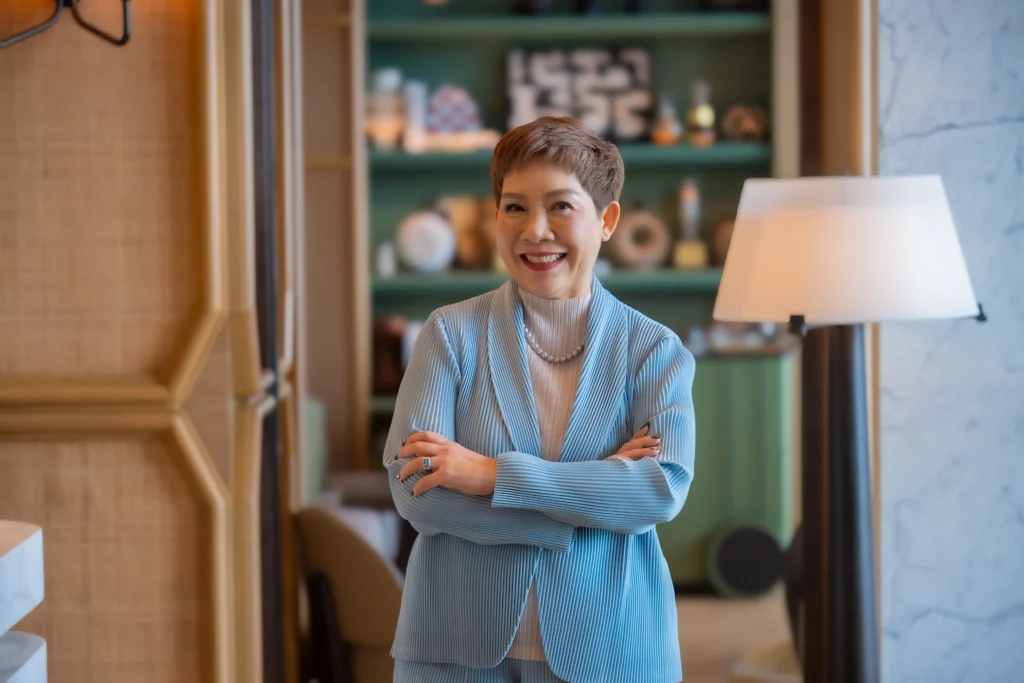
Dr Supawan Teerarat, president, TCEB
Supawan Teerarat, president of TCEB, said: “Thailand is advancing sustainability from aspiration to achievement, turning long-term commitments into measurable impacts.”
For an organiser, the trajectory is more useful than the total. A jump of that size in a single year is a capability signal rather than a policy statement. It points to a market where measurement is becoming routine rather than exceptional, which makes it considerably easier to obtain event-level data when a board asks for it.
Requirements rather than suggestions
TCEB has also changed what it asks of the industry. Its terms of reference for bidders and proposal submitters now require organisers to plan carbon-neutral events. That means calculating the event’s carbon footprint, putting reduction measures in place, and either obtaining certification or following TCEB’s guidance. Organisers are encouraged to offset residual emissions using carbon credits drawn from greenhouse gas reduction projects inside Thailand, keeping that value in the domestic economy.
The significance here is procedural as much as environmental. Sustainability stops being an annex to the bid document and becomes a condition of it. Suppliers price for it, venues plan for it, and the data exists by default rather than by request.
Support across the full event lifecycle
The commitment is backed by practical tools at each stage of an event.
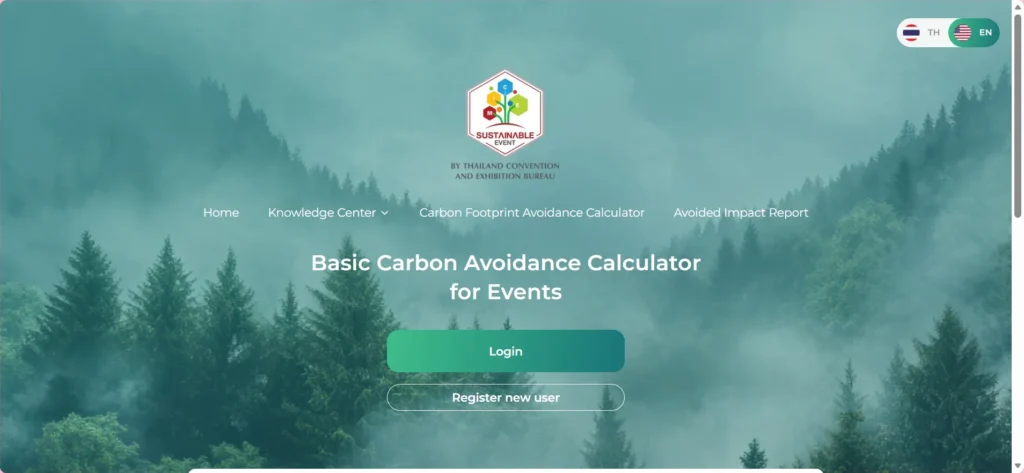
Before the event, organisers can model choices using TCEB’s carbon avoidance calculator, then source accredited partners through the Thailand Sustainable Event Management Standard (TSEMS) directory and the Thai MICE Connect marketplace. Guidance is published openly, including basic guidelines for sustainable events and a guide to organising healthy events.
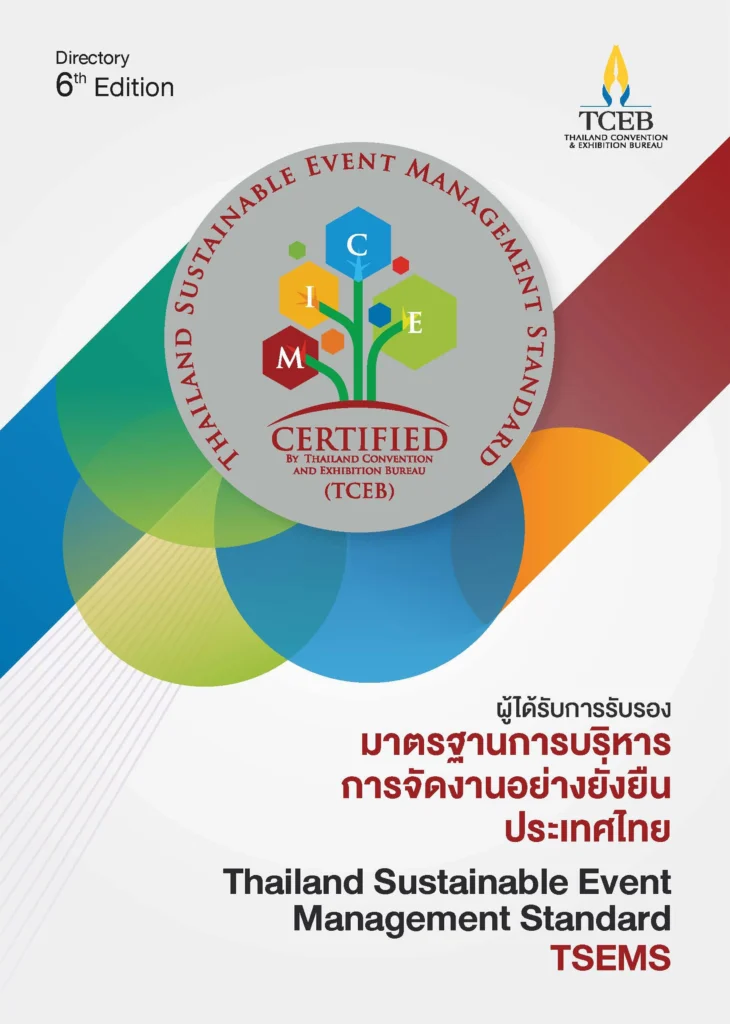
TSEMS itself is worth a closer look. Developed by TCEB, it is the national benchmark for sustainable event management in Thailand, and sits alongside the regional and international standards the bureau recognises. For an organiser, it works as a pre-qualified shortlist: suppliers already assessed against a published framework rather than a self-description.
On site, that same certified supplier network carries the plan through, supported by specialist partners such as Scholars of Sustenance Thailand on food surplus, alongside venue, catering and logistics operators working to national standard.
After the event, unavoidable emissions can be calculated and offset through the Zero Carbon application developed by the Thailand Greenhouse Gas Management Organization (TGO), with a self-declared certificate at the end of the process. Organisers who need external assurance can go further, using third-party verification and TGO certification, or working with TCEB’s recommended consultants, verifiers and carbon credit brokers.
The point of that chain is substantiation. A sustainability claim made at the close of a congress in Bangkok can be evidenced. Evidence is what association boards and corporate sponsors now expect to see.
A wider map than the capital
Thailand’s MICE readiness extends well beyond Bangkok. TCEB works through a network of 10 MICE cities: Bangkok, Pattaya, Chiang Mai, Phitsanulok, Khon Kaen, Nakhon Ratchasima, Udon Thani, Phuket, Songkhla and Surat Thani. These are supported by satellite cities including Chiang Rai, Ayutthaya and Ubon Ratchathani.
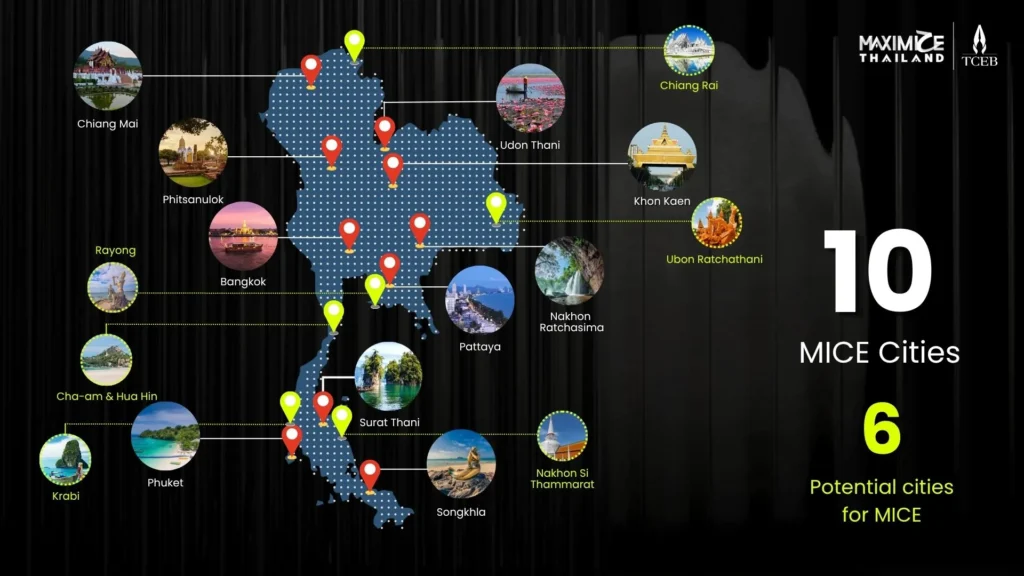
That network does two things for an organiser. It gives rotating events genuine options within a single country, with a familiar support structure in each location. And it distributes economic benefit across regions, which matters for associations whose membership expects host selection to deliver something beyond a capital city.
Connectivity underpins the whole model. Thailand’s position at the centre of ASEAN, its air links and its established venue infrastructure keep delegate journeys straightforward, which remains one of the more reliable predictors of attendance.
The human-centred difference
Thai hospitality is well documented, and easy to write off as a soft advantage. It is not. Delegate experience drives return attendance and return attendance drives an association’s financial position.
TCEB’s programming reflects that. Its seven MICE themes run from culinary journeys and cultural heritage to CSR and green meetings, giving organisers structured ways to build local content into a programme rather than bolting it on afterwards. Community-based experiences connect delegates directly with local producers and craftspeople: memorable for the delegate, and a route for spend into local economies.
That second point is where the social side of the ledger starts to add up. Sourcing locally, working with community operators and building programme content around Thai producers turns delegate spend into something an association can report on, rather than something that simply happens.
The Meet Well in Thailand campaign extends the same thinking to wellbeing, offering business travellers a journey built around purpose and rejuvenation, with partner privileges arranged through TCEB.
From potential to exponential
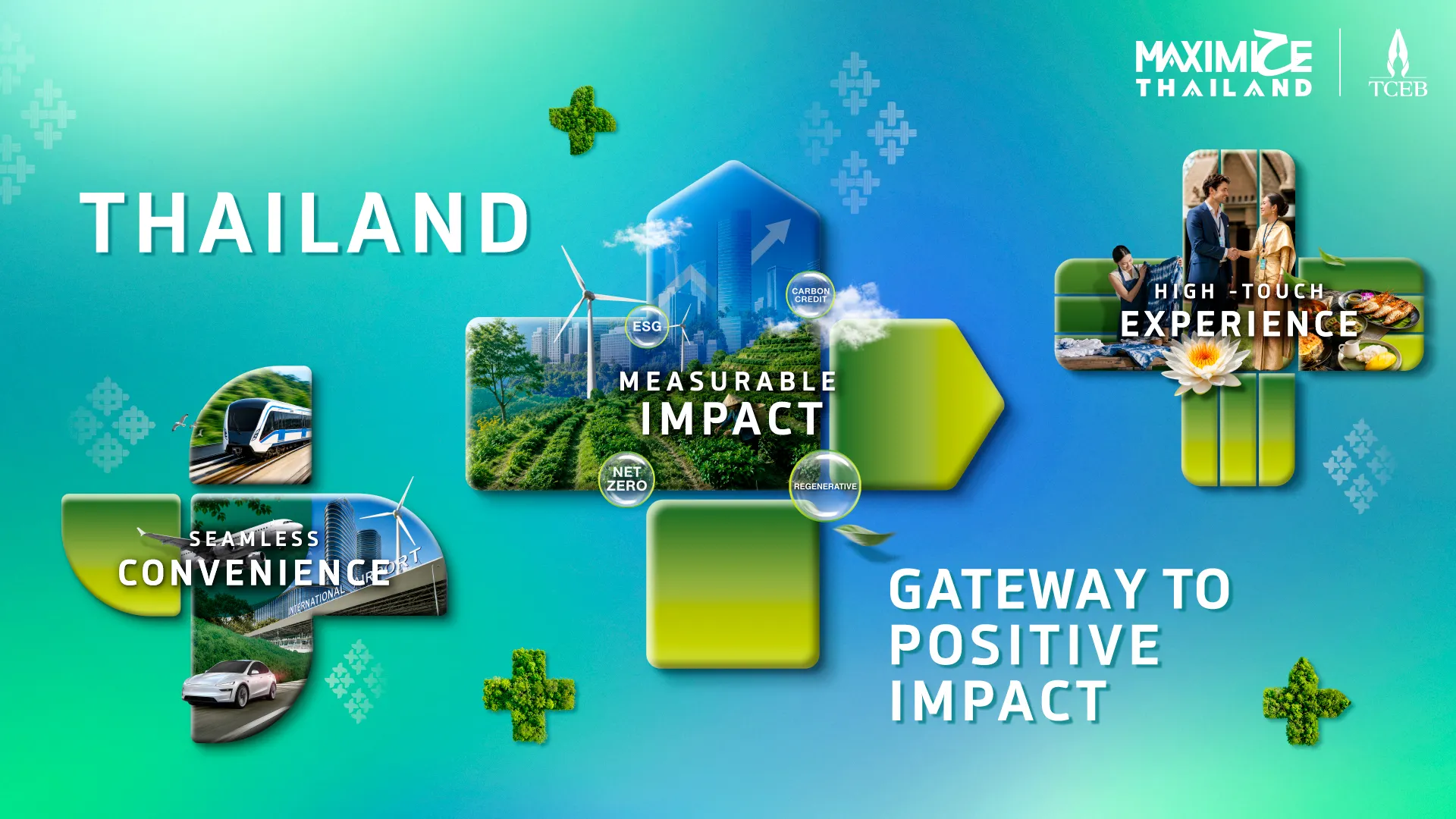
These strands come together in MaxiMICE Thailand, TCEB’s current platform, built on three pillars: convenience, experience and impact. The framing is deliberate. Convenience covers infrastructure, connectivity and the integrated MICE ecosystem. Experience covers Thai culture, creativity and human-centred design. Impact covers measurable business outcomes and long-term value for host communities.

Underpinning all three is an ESG structure spanning environmental, social and governance responsibilities, aligned to 14 sub-goals within the UN Sustainable Development Goals. TCEB does this work alongside external bodies rather than in isolation, including UNDP, UNEP, the Global Destination Sustainability Movement, the Global Sustainable Tourism Council, ICCA, UFI, PATA and the Events Industry Council.
External frameworks matter for a reason organisers will recognise immediately. A destination assessing itself will always score well. A destination measured against internationally recognised standards gives a board something it can defend.
What it means for organisers
Thailand’s proposition is not that sustainability is easy. It is that the infrastructure, the standards, the tools and the incentives are already in place, so an organiser does not have to assemble them from scratch on arrival.
For international associations and corporate planners under pressure to demonstrate value, that is a practical advantage rather than a philosophical one. The event still has to be designed well, and the outcomes still have to be earned. But the destination arrives with the measurement architecture already built, and with a bureau who’s own 2030 target depends on organisers making use of it.
Visit the TCEB MICE sustainability website to explore the tools, standards and support available for your next event in Thailand.