The conference market in Estonia’s second-largest city, Tartu, was lifted by a new wave of energy on 1 December with the opening of the V Spa Hotel & Conference Centre in the city’s commercial district.
The 79-room hotel offers five state-of-the-art conference halls of various sizes, which can be combined to create space for up to 700 delegates.
The capacity, V Spa represents a major boost to Tartu’s allure as a destination for larger conferences.
The hotel also boasts one of the largest spa complexes in the Baltic states and a 120-seat restaurant that can be used for events.
V Spa is set to join the Estonian Convention Bureau from 1 January 2017, making it the ECB’s first hotel member in Tartu.
“We at the ECB are extremely pleased that such a high-quality, high-capacity conference hotel has been added to the mix in Tartu. It will no doubt make it much easier for our Tartu Conference Ambassadors to attract and host large international gatherings,” said Estonian Convention Bureau marketing manager Riine Tiigi.
The university town of 100,000 has moved up from 176th to 115th place in the latest city rankings compiled by the International Congress and Convention Association (ICCA).
International conferences that helped boost that ranking this year included: the 71st CISM (International Military Sports Council) General Assembly and Congress in May, ASAP 8 – The Association for the Study of the Arts in September and the 6th Conferene of International Association for Ethical Literary Criticism (IAELC) in October.
Next year’s programme in the city includes the European Mathematical Genetics Meeting 2017, which comes to town in April and the Congress of the International Association of Agricultural Museums (CIMA) in May, while the 14th International Cognitive Linguistics Conference (ICLC-14 2017) is in Tartu in July.
Meanwhile, over in the Estonian capital, Tallinn, the city government has announced that the disused Linnahall entertainment complex, a large harbour-side structure dating to 1980, is to be renovated into a concert hall and large-scale conference centre.
Plans include converting Linnhall’s former ice rink into 12 multifunctional meeting rooms, the largest of which will have a capacity of 2,500 delegates.
There will also be a 3,500-seat concert hall and a 500-seat black box theatre, along with a string of shops and restaurants on the sea-facing edge of the building. Renovation is due to begin next year with 2019 set as the target for completion.
“The Estonian meetings industry wholeheartedly welcomes Tallinn’s decision to make use of the Linnahall in this way,” said Estonian Convention Bureau managing director Kadri Karu. “We are constantly receiving requests for conference spaces of this scale and this new option will allow us to host significantly more large international events.
“For a lot of conference organisers, who are already impressed by Tallinn’s high-quality hotels and easily walkable city centre, a 2,500-person venue will be the final puzzle piece that cinches the deal.”
Deputy mayor Taavi Aas said that the project to breathe new life back into the long-neglected complex would cost between €80m and €100m, with the city and state budgets each supplying roughly half the sum.
Designed by architects Raine Karp and Riina Altmäe, the 37,000sqm Linnahall was one of many grandiose construction projects undertaken to coincide with Tallinn’s hosting the sailing events of the Moscow Olympic Games. It has largely fallen into disrepair since the end of Soviet rule.
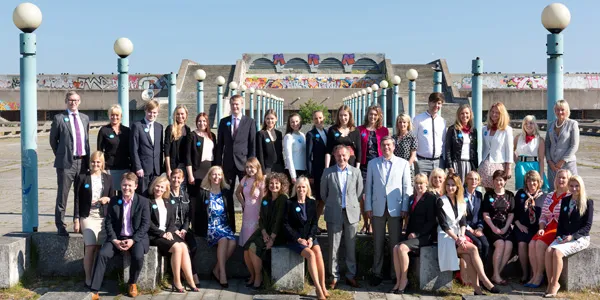
Caption: Team Estonia on the roof of Linnahall