At Cvent CONNECT Europe recently, BAFTA award-winning presenter, Claudia Winkleman sat down with Cvent CEO and founder, Reggie Aggarwal to discuss everything from Blackstone’s recent multi-billion dollar acquisition to use of generative AI.
CW: It has been just over six months since Cvent became part of Blackstone. How’s that going?
RA: Blackstone took us private a few months ago after we’d been trading publicly on the Nasdaq Stock Market. It’s fantastic to be a part of an organisation with such deep pockets. Blackstone understands our space having owned the Hilton hotel chain for several years. I also like the fact that Blackstone invests in innovation and the long-term growth of ‘durable’ companies so it encourages our 1,400 Cvent engineers to continue focusing on R&D and maintain our innovative culture.
At Cvent CONNECT in 2020, you told a virtual-only audience that we were entering the ‘Golden Age of Events’. It was the start of the pandemic, everyone was in lockdown. Didn’t everyone think you’d gone crazy?
Even I thought I’d gone a little crazy! But it was a time that required boldness. In times of crisis, people need bold and forward-thinking leadership. I knew that, despite the growing crisis the events industry was facing, technology was booming and tech stocks were going through the roof. A study from McKinsey said that 10 years of technology evolution occurred in just 12 months during this period. We were seeing the rapid acceleration of other sectors becoming digitalised and we knew the same thing would happen to our industry once recovery took hold. The power and influence of events have grown as a result of this accelerated digitalisation. We now have more channels, more ways to engage and more opportunities to reach all types of people. It’s only going to get better.
How did Cvent start?
I used to be a corporate lawyer and launched a non-profit in 1996. I found myself organising 25-30 events a year and the tools I used were Excel, Outlook and yellow sticky notes. It was a painful experience so I took that painpoint and created the aspirin. The aspirin was Cvent.
Did it run smoothly at the beginning?
Whenever you start a company, there are always low points. People don’t tend to hear about all the companies that fail or the struggles that entrepreneurs face until they become successful. For us, it was the year 2000 and the Dotcom boom was in full swing. We were one of around 500 other event registration companies based along the West Coast of America, reliant on over $1bn of venture capital. To compete we needed to grow fast so we raised $17m from a bunch of investors and scaled from six people to 125 staff in a single year. When the perfect storm of 09/11 and the dotcom meltdown hit, so too did reality. We blew through $16.6m of that $17m to keep a company afloat that was doing $1.5m in revenues. We were on the point of bankruptcy and had to cut 80% of our staff. It was a major low point in my life. You start questioning yourself, you question the business model. Then your investors start trying to micro-manage a business they don’t necessarily understand so the situation gets worse. I didn’t take a salary for three years. For almost a year, it was hard for me to get out of bed. My mum who forced me to go into the office every day and kept me moving forward. You learn more on the way down than you do on the way up. And the things you learn will always help you in the next difficult time. You also have to be persistent and consistent. Many entrepreneurs give up too easily. Nothing in life is easy to build. I love a Japanese proverb that says: ‘You can fall down seven times, but you get up eight times’. The problem is that too many people just stay down after the seventh fall. Between 2001 and 2005, we learned the most and our culture was formed. We learned to stick to the basics and prioritise long-term profitability over short-term sales. The fundamentals for us were to build the best products, hire the best people and listen to our customers. It’s the same mantra as we have today. 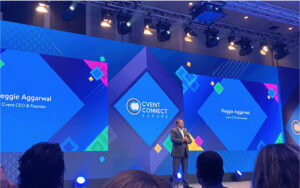
How did you then navigate Cvent through the pandemic?
It was extraordinarily difficult. At the start of the pandemic, 96% of our revenue came from in-person events. We didn’t have a virtual product. In those first few weeks, over 10,000 customers phoned us to say they wanted out of their contracts because if we couldn’t do virtual events, they needed to find a company that could. I was so impressed that our people didn’t panic and instead we planned a pivot that saw us build a virtual product in just five months. It launched at Cvent CONNECT in 2020 and we had 42,000 people register to experience it, It was our Moon landing because if it had failed in front of all those customers, the ramifications for our future business would have been catastrophic. Again, it was a time to be bold and make bold bets.
What does good leadership mean to you?
Leadership fundamentally comes down to hiring the best people. Your people are the DNA of your company and they are your most important asset. You need to give them direction and then provide them with the freedom to perform. If you do that, you’ll have thousands of internal entrepreneurs helping you to run your company at scale.
Tell us a bit about the importance of customers.
I’ve spent a lot of time with our customers over the past 24 years. They’ve become friends, we’ve shared stories and life events and it’s very special. What I’ve learned is that meeting planners in particular are very smart – they know what they want and in many ways, they’re mini CEOs managing budgets, sponsorship, logistics and actual businesses within larger organisations. If you listen to them, 90% of your roadmap is set because they’ll tell you their pain points and empower you to create the aspirin.
What does the future hold for the events industry?
Technology solutions such as facial recognition and Augmented Reality still have a way to go but others such as AI and Machine Learning (ML) are transformative for our industry. Video also plays a vital role, extending the life of your event content throughout the year. The power of the event planner as part of the marketing function of a company will also grow in importance as the different methodologies available to reach and influence new audiences continue to scale.
Give us your thoughts on AI.
Generative AI is growing twice as fast as the evolution of the mobile phone. Initially, it has made our 5,000 employees more efficient through automation. Now, both AI and ML have empowered our developers to develop 15% faster because they can predict the code that our people are writing. It’s still early days but a simple example is to give customers generative AI writing tools that will help them to construct formatted event emails and more concise agendas. I don’t believe AI will ever replace meetings and event planners but it will continue to empower them to do better and accelerate their careers.