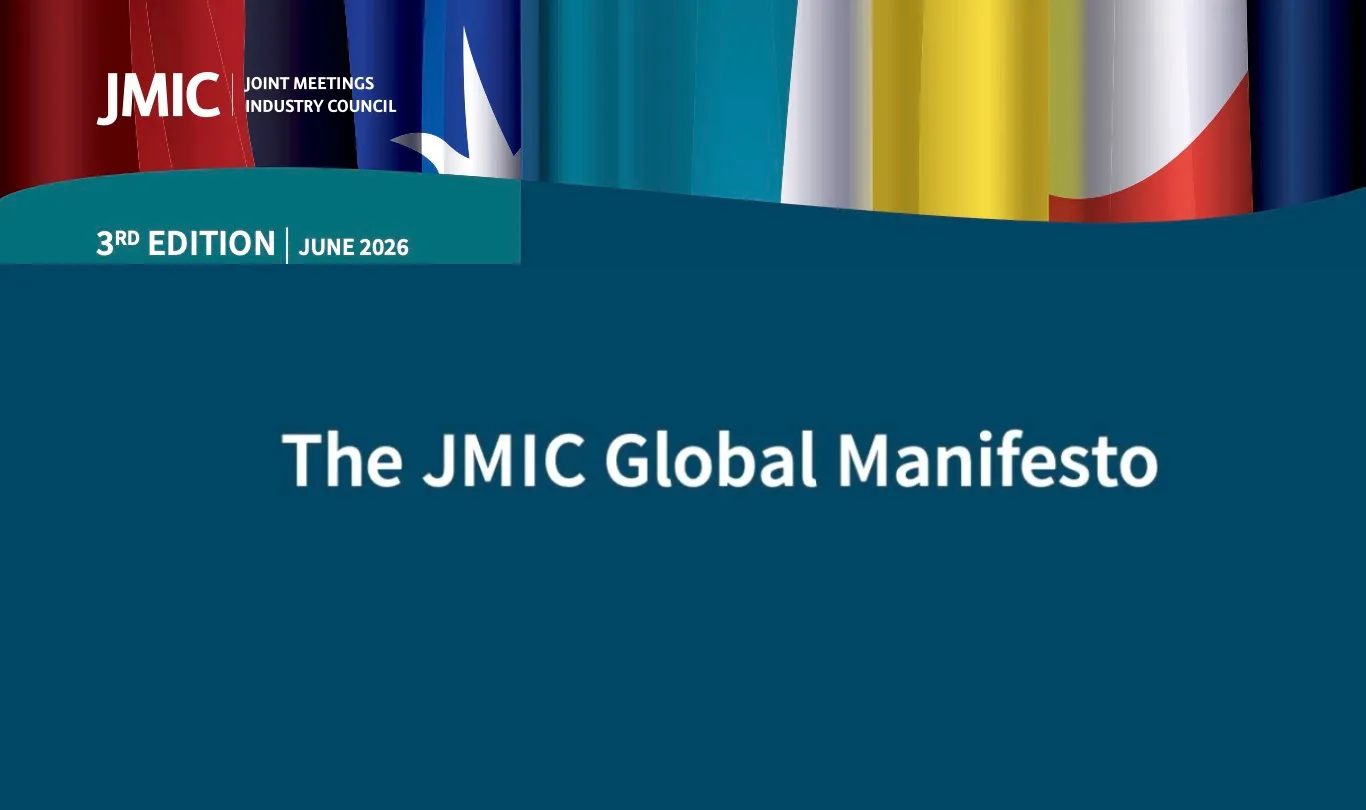
The Joint Meetings Industry Council (JMIC) publishes today (16 July) its third edition of the JMIC Global Manifesto, an updated and expanded version of the industry’s flagship advocacy resource for positioning business events as drivers of economic, social and professional transformation. CMW was given an exclusive first look at this major new tool demonstrating the industry’s real value.
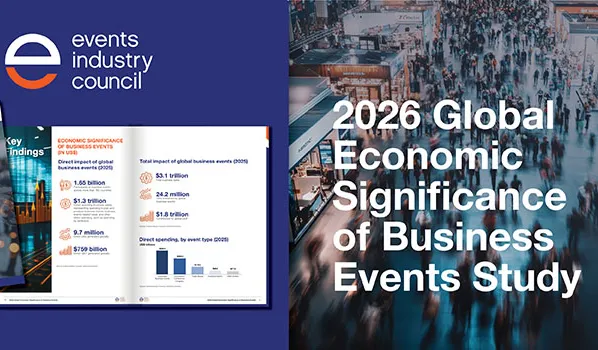
First published in 2020 to support the sector’s post-pandemic recovery, and revised in 2023 to build the industry rationale for business events as agents of growth, this third edition draws on the latest data from the Events Industry Council’s 2026 Global Economic Significance Study alongside a wide range of association and sector sources. It sets out 15 ways in which business events create strategic advantage for governments and destinations, from building trust and community legacies to supporting talent development, sustainability and measurable ROI.
A key addition to the new edition is the integration of case studies and legacy narratives from The Iceberg, JMIC’s impact storytelling platform. Where economic data demonstrates the scale of the industry’s contribution, The Iceberg’s case studies illustrate the lasting, often less visible legacies that business events leave behind in host communities. Together, the two resources give industry professionals and policymakers both the figures and the stories needed to make the case for business events as strategic policy tools.
The Manifesto also sets out ten practical steps for delivering the industry’s message locally, reflecting JMIC’s position that a single global narrative must be adapted and owned by national, regional and local stakeholders to be eYective with their own governments and public authorities.
The third edition was developed by a JMIC working group which included:
- Martin Boyle, CEO, IAPCO (Working Group lead)
- Gemmeke De Jongh, senior manager education and impact, ICCA
- Alex Alles, senior director advocacy & sustainability, ICCA
- Peirui Tan, programme manager advocacy and alliances, UFI
- Gregor Bischkopf, executive director, IFES
- Bettina Reventlow-Mourier, deputy convention director – head of congress, Copenhagen Convention Bureau
James Rees, president of JMIC, said: “JMIC’s role in supporting the global business events industry is to provide a platform where the world’s business events associations and industry stakeholders speak with one voice. The Global Manifesto is a detailed manifestation of such a platform which, having supported the industry in its recovery from the pandemic, has rightly been designed and adapted for the world in which we now operate and will be an invaluable tool for colleagues and stakeholders across all regions to support their advocacy work and demonstrate the powerful, lasting impact and legacy of business events.”
Step-by-step guide
Speaking exclusively to CMW ahead of publication, Martin Boyle, CEO of IAPCO and lead of the Working Group, said: “Edition 3 of the JMIC Global Manifesto, focuses on supporting the global meetings and events industry by providing a step-by-step guide to advocating to policymakers and stakeholders.
“The first edition was developed as a unified advocacy document to help the global meetings and events industry speak with one voice. Its primary objective was to demonstrate to governments and policymakers that business events were not simply tourism activities, but strategic economic development tools that could accelerate recovery and renewal.
“The second edition retained the original framework but significantly broadened its perspective. Rather than focusing primarily on post-pandemic recovery, it repositioned business events as permanent strategic assets that help societies tackle long-term global challenges.
“This edition is a practical step-by-step guide written to help organisations and their teams across our industry to develop and deliver their own advocacy strategy at local and regional levels. How does one begin to talk with policymakers, how does one craft their message and how does one get ‘a foot in the door’ to have such important questions? Edition 3 answers all these questions and more and provides real life success stories that illustrate the value proposition the industry brings to cities, regions and societies.”
He added: “This Manifesto takes a truly global perspective, while recognising that successful advocacy is ultimately delivered through relevant local messages. Drawing on research data from the Events Industry Council (EIC), the member associations of the Joint Meetings Industry Council (JMIC) and others across the meetings and events sector, it has been designed as a practical and accessible guide, equipping meetings industry professionals with clear, adaptable messaging to support advocacy initiatives and stakeholder discussions, whether speaking as a member of one of our global meetings and events industry associations or advocating as an independent company. As CEO of IAPCO, we will be using the Manifesto ourselves, but will also be leveraging its content by sharing it with all of our members as we support them through their own grass-roots advocacy work.”
Boyle noted significant data was gathered from across the JMIC membership and wider connections. “Whilst we need quantifiable data regarding the economic value of our industry which we gathered from our friends at EIC, we also felt it important to include other relevant data from UFI (Economic Impact Study, April 2026), AUMA (Added Value of Trade Fair Visits report, November 2024), NZCE (Trade Show Travel Balance report, January 2024) and ICCA’s 2025 Rankings report to name a few.”
Regional needs
Does the unifying messaging clash at all with differing regional needs, cultures and stages of development, I asked? Can one size fit all here?
“A local, cultural and regional approach is essential to the success of any conversation. However, the underlying message must remain consistent in order for our global industry to be recognised as that – an industry.”
James Rees added that the JMIC Global Manifesto is not a one-size-fits-all document, “rather a tool to provide core information to build an advocacy campaign suited to any particular region, country or city destination.”
Rees underlined that part of JMIC’s purpose going forward is to make sure the industry is fully aware of, and uses, the Manifesto to develop strategic advocacy campaigns with which to influence the policymakers whose decisions can negatively impact the business events sector.
So, how did the Working Group decide on the ‘15 Ways Business Events Create Strategic Advantage in Multidimensional Growth and Transformation’?
“This was one of the most difficult parts of designing Edition 3,” said Boyle. “The Working Group was focused on ensuring the Manifesto would be easy to follow, resonate across our diverse global industry and remain consistent with the structure of the previous editions… We considered what would be of value and helpful to one person trying to build their advocacy strategy and action plan and viewed the 15-step process through their lens. By personalising it in this way, the steps became crystal clear.”
The Joint Meetings Industry Council (JMIC) is the global umbrella body for the major associations representing the business events industry.
The full JMIC Global Manifesto, 3rd Edition, is available at www.themeetingsindustry.org. Further case studies and legacy narratives are available at www.the-iceberg.org.